

Discovery of Small X-ray Ring around Crab Pulsar Solves Old Mystery
Discovery of Small X-ray Ring around Crab Pulsar Solves Old Mystery
| 15 October 1999 |
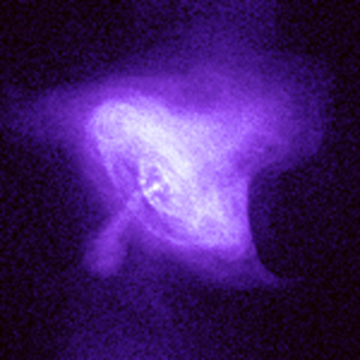
Recent images obtained with the Chandra X-ray Observatory have uncovered part of the secrets of the Crab Nebula by revealing a bright small ring around its center. Scientists had long searched for the missing link between the central pulsar and the nebula and it would seem that their quest is now over.
|
| NASA/CXO/SAO |
"It has never been seen before," a jubilant Jeff Hester, an associate professor at Arizona State University, said at the press conference where he was presenting the discovery, "It should tell us a lot about how the energy from the pulsar gets into the nebula." Hester is one of the world experts on the Crab Nebula and the leader of a monitoring research project carried using both the Hubble Space Telescope and the Chandra X-ray Observatory.
The Crab Nebula is the remnant of a stellar explosion which occurred at the beginning of the millennium. The event, which was recorded by Chinese and Japanese astronomers, produced a pulsar (a fast rotating neutron star) and a bright nebula around it. The system has been studied intensively -- Hester joked that every astronomer had at least once used it in their research -- but several mysteries still remained.
The neutron star in the Crab Nebula was formed when a massive star, running out of its nuclear fuel, collapsed under the pressure of its own gravity. With less than 40 miles circumference at the equator, it would be easy to bike around neutron stars if it were not for their surface gravity of 200,000,000,000 times that of the Earth. Neutron stars can rotate very rapidly and because of their large surface magnetic fields, they act as efficient particle accelerators.
A spinning neutron star releasing a beam of photons and particles acts like a giant light house. Each time the beam's path crosses that of the Earth, astronomers detect an increase of incoming radiation. This is why these objects are called "pulsars". It is not known if all neutron stars are pulsars.
One of the remaining mysteries about the Crab was the way the energy was transferred from the pulsar to the nebula. Astronomers knew that particles were accelerated by the pulsar and injected into the nebula, but they didn't know how. "It's a lot like a waterfall hitting some rocks at the bottom and splattering in all directions," said Hester in a phone interview. The electrons are accelerated by the pulsar, moving together at speeds up to 99.999% that of light. Hester surmises that the place where they get splattered into the nebula is the small bright ring close to the pulsar which appears on the new Chandra image - a cosmic equivalent of the rocks at the bottom of the waterfall. "It is the most likely candidate," says Hester, "Because it is sitting in the right place and it stands out in the high-energy image." The other spectacular features of the Chandra image (the large ring and the jets) had been detected during observations with the ROSAT satellite.
The Chandra X-ray Observatory is the latest of NASA's great observatories project. It was launched this past summer and has an expected life time of five to ten years. The observatory was named after the late Subrahmanyan Chandrasekhar, a professor at the university of Chicago who pioneered many of the ideas about neutron stars. Chandra also means "moon" in Sanskrit.