
 Read more about
 Imagine the Universe News - 16 May 2007
Astronomers Find Ring of Dark Matter with Hubble Space Telescope
| 16 May 2007 |
 Click image to enlarge. |
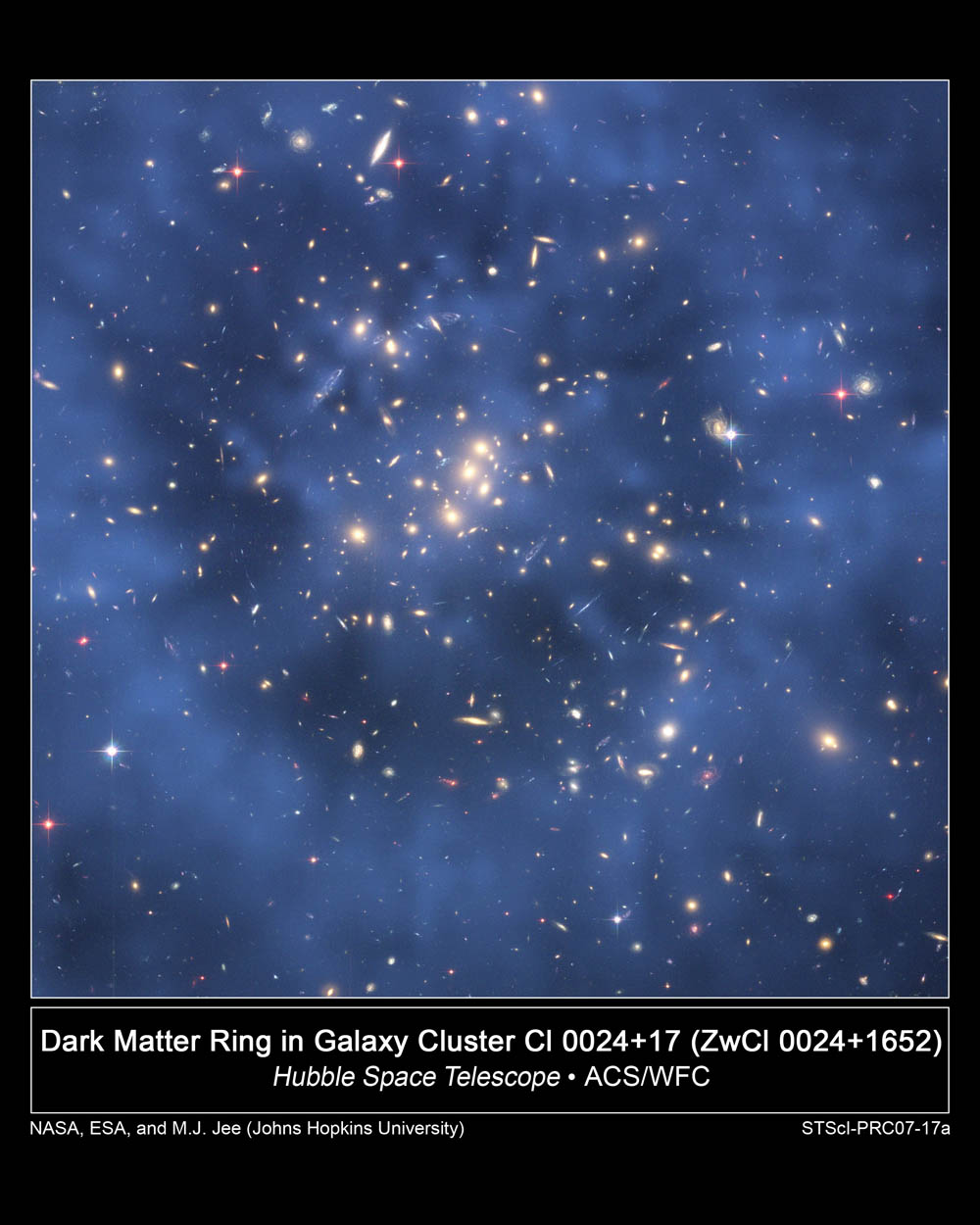
| This Hubble Space Telescope composite image shows a ghostly "ring" of dark matter in the galaxy cluster Cl 0024+17. The ring-like structure is evident in the blue map of the cluster's dark matter distribution. The map is superimposed on a Hubble image of the cluster. Credit: NASA, ESA, M.J. Jee and H. Ford (Johns Hopkins University) |
Astronomers using NASA's Hubble Space Telescope have discovered a ghostly ring of dark matter that formed long ago during a titanic collision between two galaxy clusters. Dark matter makes up most of the physical material in the Universe's material, while ordinary matter, which makes up stars and planets, comprises only a small percentage. The ring's discovery is among the strongest evidence yet that dark matter exists.
Astronomers have long suspected the existence of dark matter and theorized that it is the source of additional gravity that holds galaxy clusters together. Such clusters would fly apart if they relied only on the gravity from their visible stars. Although astronomers do not know what composes dark matter, they hypothesize that it is a type of elementary particle that pervades the Universe.
"This is the first time we have detected dark matter as having a unique structure that is different from both the gas and the galaxies in the cluster," said astronomer M. James Jee of Johns Hopkins University in Baltimore. Jee is a member of the team that spotted the dark matter ring.
The ring, which measures 2.6 million light-years across, was found in the cluster CL0024+17, located 5 billion light-years from Earth. The team unexpectedly found the ring while it was mapping the distribution of dark matter within the cluster. During the team's analysis, they noticed a ripple in the distribution of the dark matter, somewhat like the ripples created in a pond from a stone plopping into the water.
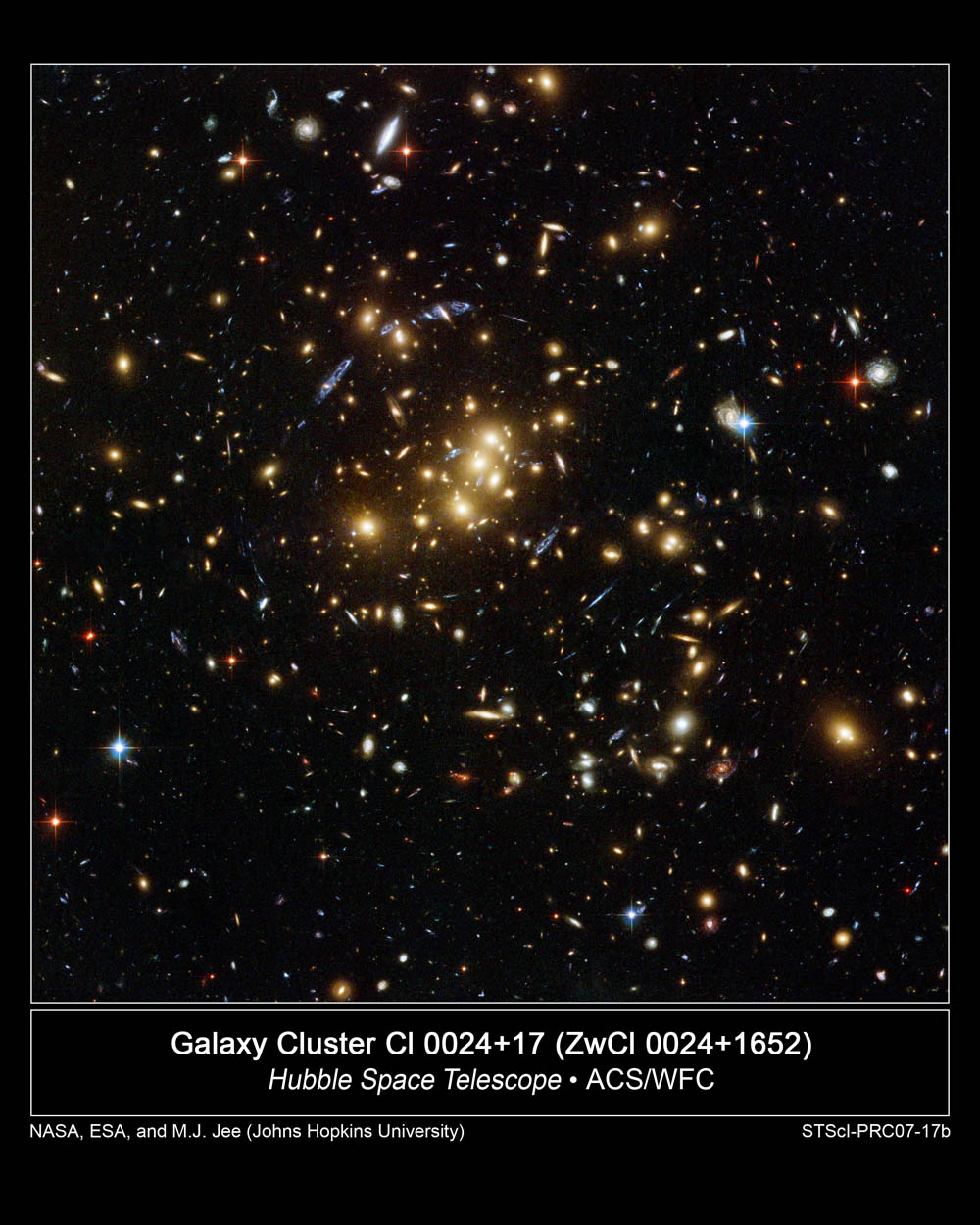
Tracing dark matter is not an easy task because it does not shine or reflect light. Astronomers detect its influence by how its gravity affects light. To find dark matter, astronomers study how faint light from more distant galaxies is distorted and smeared into arcs and streaks by the gravity of the dark matter in a foreground galaxy cluster. This powerful phenomenon is called gravitational lensing. By mapping the distorted light, astronomers can deduce the cluster's mass and trace how dark matter is distributed in the cluster.
 Click image to enlarge. |
| This rich galaxy cluster, catalogued as Cl 0024+17, is allowing astronomers to probe the distribution of dark matter in space. The blue streaks near the center of the image are the smeared images of very distant galaxies that are not part of the cluster. The distant galaxies appear distorted because their light is being bent and magnified by the powerful gravity of Cl 0024+17, an effect called gravitational lensing. Credit: NASA, ESA, M.J. Jee and H. Ford (Johns Hopkins University). |
Jee said, "Although the invisible matter has been found before in other galaxy clusters, it has never been detected to be so largely separated from the hot gas and the galaxies that make up galaxy clusters. By seeing a dark matter structure that is not traced by galaxies and hot gas, we can study how it behaves differently from normal matter."
Jee explained, "I was annoyed when I saw the ring because I thought it was an artifact, which would have implied a flaw in our data reduction. I couldn't believe my result. But the more I tried to remove the ring, the more it showed up. It took more than a year to convince myself that the ring was real. I have looked at a number of clusters, and I haven't seen anything like this."
Curious about why the ring was in the cluster and how it had formed, Jee found previous research that suggested the cluster had collided with another cluster 1 to 2 billion years ago. The research, published in 2002 by Oliver Czoske of the Argelander-Institute for Astronomy at the University of Bonn, was based on spectroscopic observations of the cluster's three-dimensional structure. The study revealed two distinct groupings of galaxies clusters, indicating a collision between two clusters.
Astronomers have a head-on view of the collision because it occurred along Earth's line of sight. From this perspective, the dark-matter structure looks like a ring.
The team created simulations showing what happens when galaxy clusters collide. As the two clusters smash together, the dark matter, as calculated in the simulations, falls to the center of the combined cluster and sloshes back out. As the dark matter moves outward, it begins to slow down under the pull of gravity. It then piles up, like cars bunched up on a freeway.
"By studying this collision, we are seeing how dark matter responds to gravity," said team member Holland Ford, also of Johns Hopkins University. "Nature is doing an experiment for us that we can't do in a lab, and it agrees with our theoretical models."
"The collision between the two galaxy clusters created a ripple of dark matter that left distinct footprints in the shapes of the background galaxies," Jee explained. "It's like looking at the pebbles on the bottom of a pond with ripples on the surface. The pebbles' shapes appear to change as the ripples pass over them. So, too, the background galaxies behind the ring show coherent changes in their shapes due to the presence of the dense ring."
Jee and his colleagues used Hubble's Advanced Camera for Surveys to look behind the cluster to detect the faint, distorted, faraway galaxies that cannot be resolved with ground-based telescopes. "Hubble's exquisite images and unparalleled sensitivity to faint galaxies make it the only tool for this measurement," said team member Richard White of the Space Telescope Science Institute in Baltimore.
Previously, observations of the Bullet Cluster with Hubble and the Chandra X-ray Observatory presented a sideways view of a similar encounter between two galaxy clusters. In that collision, the dark matter was pulled apart from the hot cluster gas, but the dark matter still followed the distribution of cluster galaxies. CL0024+17 is the first cluster to show a dark matter distribution that differs from the distribution of both the galaxies and the hot gas.
The team's paper has been accepted for publication in the June 1, 2007 issue of Astrophysical Journal.
The Hubble Space Telescope is a project of international cooperation between NASA and the European Space Agency. The Space Telescope Science Institute conducts Hubble science operations. The institute is operated for NASA by the Association of Universities for Research in Astronomy, Inc., Washington.