

Astronomers Find First Direct Evidence Linking Black Holes and Supernovae
Astronomers Find First Direct Evidence Linking Black Holes and Supernovae
| 21 September 1999 |
Astronomers believe that black holes are the evolutionary endpoints of stars at least 10 to 15 times as massive as the Sun. If such a star undergoes a violent supernova explosion, the core of the star it leaves behind may gravitationally collapse in on itself, creating a singularity - an entity with zero volume and infinite density - a black hole.
The first direct evidence that black holes are created by supernova explosions comes from a source known as GRO J1655-40, which lies 10,000 light years away in the direction of the constellation Scorpius. It was discovered in 1994 by BATSE as an X-ray nova. Because there was also an optical nova at the same time, it is also known as Nova Sco 1994. The source had several short X-ray outburst events until the summer of 1995, when it went quiet. Results from this initial series of outbursts showed it to be a black hole having a mass of 7 solar masses (and one of the best measured black hole masses at that !). It is in a binary star system with a normal star, and has an orbital period of about 2 days.
The Rossi X-ray Timing Explorer's (RXTE) All-Sky Monitor (ASM) instrument first detected a subsequent outburst in spring of 1996. This activity lasted well into 1997 and was well observed by RXTE. Data for this source from RXTE was also used to show evidence of frame dragging near a black hole. This source also exhibits superluminal jets, and is one of two microquasars in our galaxy.

|
|
Radio observations of GRO J1655-40 in August and September 1994
showed jets of gas shooting out at up to 92 percent of the speed of light. (NRAO) |
In the latest news, focus has turned to the companion star of GRO J1655-40. Researchers from the Institute of Astrophysics of the Canary Islands and the University of California, Berkeley have detected large abundances of heavy elements in this companion star - elements created in such abundances only in supernova explosions. They think that the supernova that created GRO J1655-40 may be responsible for flinging this material into its companion star.
Rafael Rebolo of the Institute of Astrophysics of the Canary Islands told ABC News, "What we thought was that this star could have retained a signature, the fingerprint, of the formation process of the black hole." In other words, an exploding star blows off a large quantity of material and if there is a companion star anywhere nearby, it should contain material evidence of that explosion.
This is exactly what the researchers found. By looking at the spectrum of GRO J1655-40's companion, they found that its atmosphere contained overabundances of oxygen, magnesium, silicon, and sulphur. These heavy elements should not exist in such large quantities in a normal star - they were likely expelled during the explosion of GRO J1655-40. "The only way you can produce an excess of these elements is through several billions of degrees," Rebolo said to the Associated Press (AP), "The only way to reach these temperatures is when a star goes to a supernova situation."
John Cowan, professor at the University of Oklahoma in Norman, commented to the AP, "The explanation offered by the researchers is the most straightforward and logical one. There could be some other explanation, but it would have to be more convoluted." According to ABC News, Rebolo said that the elements could not have come from the original gas cloud that formed the stars. "We don't know of any other way to enrich the companion star so drastically with [these] elements." He added to Reuters News Service, "This is the first time these elements have been observed in a star linked to a black hole. The content is quite anomalous. We argue that these anomalies are related to the fate of the precursor of the black hole. There is no alternative way to explain this."
The supernova explosion that created GRO J1655-40 likely happened a million years ago. Long enough, Rebolo reported to ABC, that the clouds of expanding gas shot outward have since dissipated. Supernova remnants, the expelled gas from a supernova explosion, can remain visible for 100,000 years before being dispersed into space.
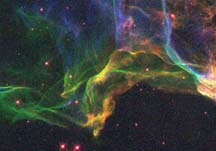 Credit: AURA/STScI |
Rebolo and his collaborators in Spain and at UC Berkeley used the Keck I telescope in Hawaii - their findings are published in the Sept. 9, 1999 issue of Nature along with Professor Cowan's commentary.