Astronomy was at first a visual science. Scientists peered at the
skies, making catalogs of what they saw, describing forms and colors of
unknown objects. Modern age astronomers also look at the sky, but they
do so with much better instruments - instruments that have extended
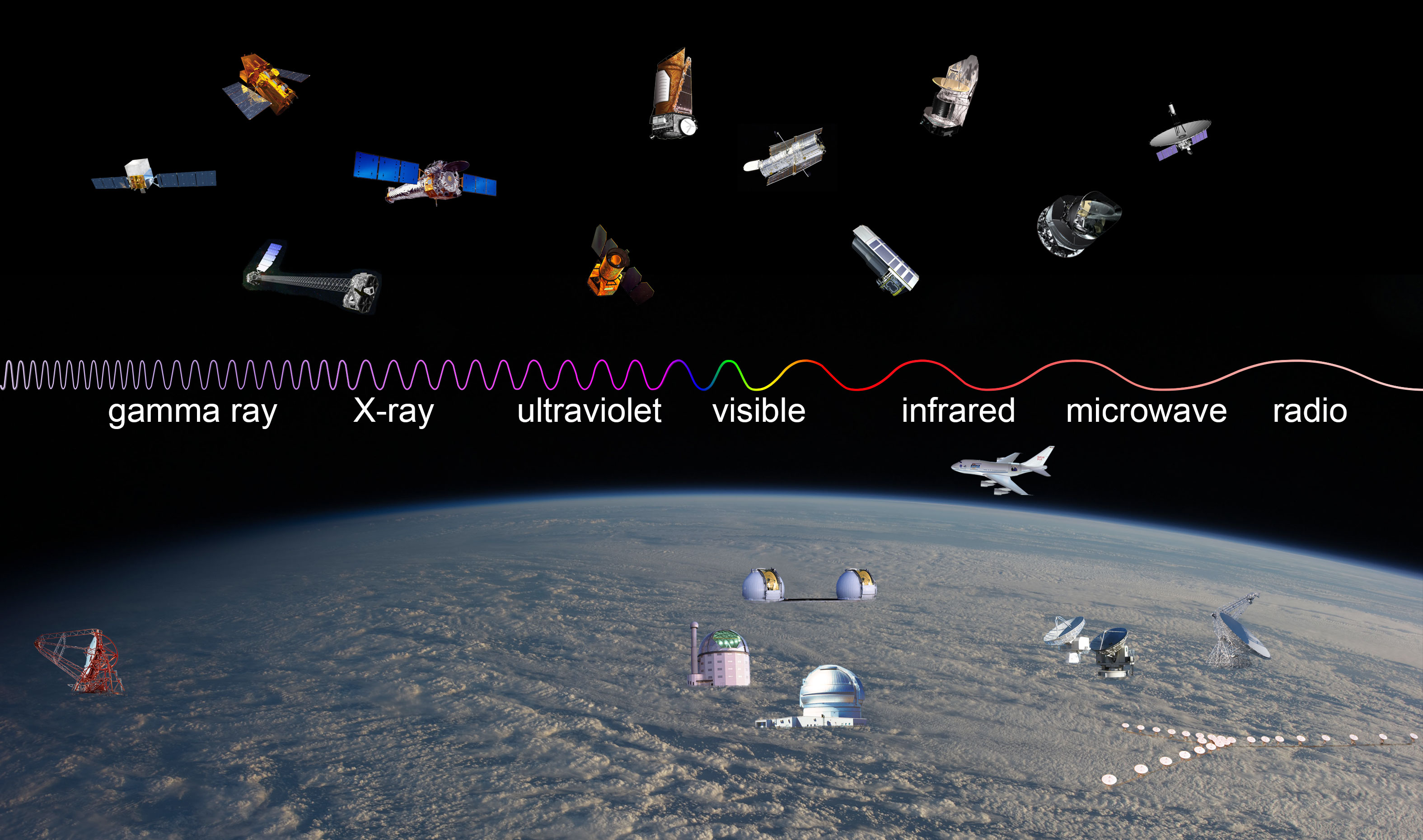
their quest to parts of the electromagnetic
spectrum that our eyes can't see.
In everyday life, your eyes act as lenses and focus
light onto your retina. Your brain
reconstructs an image, allowing you to see. Just like a photo taken with
a camera out of focus, if your eyes are not working as perfect lenses,
you will see a blurred picture. One example of how imperfect optics can
hinder the effectiveness of an instrument is the Hubble Space Telescope.
After the telescope was placed in orbit, it became apparent that the
primary mirror in Hubble's Wide Field and Planetary Camera 1 had a flaw.
It was just barely the wrong shape, and the light reflected from the
edges of the mirror was focused differently than the light at the center
of the mirror. This spherical aberration produced a blurry image.
However, engineers were able to fix this flaw by installing corrective
optics when the Wide Field and Planetary Camera 2 was installed,
bringing the telescope back into proper focus.
At left: Hubble's Wide Field Planetary
Camera 1 image of the M100 galactic nucleus, demonstrating the blur
resulting from WFPC1's flawed primary mirror. At right: A much
clearer image of the same object, after Wide Field and Planetary
Camera 2 was installed.
One challenge of very high-energy
astronomy – from
ultraviolet and above –
is the ability to build a "lens" to focus the incoming
photons
on a detector. Once the
light is collected by detectors at the focus of the lens, the
image is
reconstructed using
computers to process the recorded signal. High-energy optics often
consist of pairs of paraboloid and hyperboloid mirrors that are nested
and coated. The incoming photons bounce off the mirrors' surfaces and
are directed toward the
collecting area of the
detector.
Chandra ACIS-I image of the Crab nebula
(click on the image for a larger view).
There are many examples of the power of high-resolution imaging to
solve long-standing mysteries. The image to the right shows an image of
the Crab Nebula obtained with the ACIS-I onboard the
Chandra
Observatory. The image shows the large ring and
jets that had been seen previously
by ROSAT.
But the
image also revealed the existence of a bright, small ring surrounding
the center of the nebula that had never been seen. That ring is probably
where the
electrons
accelerated by the
pulsar
get splattered into the nebula. The
transfer was, until that point, a complete mystery because the previous
images were too blurred to see the details of what was happening in the
region closest to the pulsar. The other spectacular features of the
Chandra image (the large ring and the jets) had been detected during
observations with the ROSAT satellite's HRI instrument.
Chandra has since monitored the Crab nebula frequently, and the video
below shows a time lapse of Crab images over a span of seven months.
Over even such a small period of time, the Crab can be seen to
change.
NASA's Chandra X-ray Obeservatory captured
this sequence of still images (here animated into a video) over a
span of seven months. Even over this relatively small time period,
noticeable changes take place in the nebula. The pulsar is visible
as a white dot in the middle of the image.
(Credit: NASA/CXC/MSFC/M. Weisskopf et al & A. Hobart)
The images below show another object (the supernova remnant
Cassiopeia A) as observed by two generations of
X-ray detectors.
The image of Cassiopeia A shown
at the lower right was also obtained using ACIS-I. The details present
in this picture allowed scientists to see for the first time that there
was probably a pulsar (a spinning
neutron star)
hidden in the middle of the remnant. It appears as a small point source
almost exactly at the center of the image. It was not visible in
previous images of Cassiopeia A.
Reconstructed X-ray images from the
supernova remnant Cassiopeia A, the remains of a supernova explosion
which probably occurred in the middle of the seventeenth century.
The images are from different instruments on-board of three
different satellites. From left: Einstein IPC, ROSAT PSPC, ROSAT
HRI, and Chandra ACIS-I.
One of the big improvements between the
Einstein HRI, ROSAT HRI and Chandra ACIS-I is the
spectral
response of the latter, unavailable for the first two detectors.
Higher resolution does not only mean better images. As the need for
higher resolution images increased, so did the need for higher
resolution
spectroscopy. The ability to distinguish between
emission lines from different
elements turned out to be a powerful diagnostic
tool for the characterization of objects probed. Every object emits
radiation
that reveals its interaction with its environment. For example, a
plasma spectrum will show emission
lines for all the elements present. The strength, the width and the
energy of those emission lines provide crucial information about the
plasma itself (its temperature, density,and composition). These studies
hinge on the ability to disentangle the contributions from different
elements and identify their signature line emission. The images below
show the spectrum of a young supernova remnant as it was observed by
different detectors spanning two decades of
X-ray missions. It becomes apparent how much
easier it is to identify the contributions of all the elements present
in the remnant when the energy resolution is better.
Graphs representing the emission spectrum
of an average supernova remnant as detected by four X-ray instruments.
The detectors are from top to bottom, left to right: ROSAT PSPC,
Einstein SSS, ASCA SIS, and XXM MOS.
There were two main problems that faced scientists tackling
high-resolution spectroscopy in its early days: one was the minuscule
size of the detectors and the small portion of the sky they covered; the
second was the difficulty in interpreting and identifying the measured
emission lines. This required reliable theoretical computations for line
emission strength, or precise measurement of those lines in a
laboratory. Ideally, both would be put into use. Now, thanks to
improvements in the optics used in recently launched observatories,
scientists can obtain much more detailed readings of spectra –
essentially, the lines are sharper, allowing for more precise assessment
of the chemical composition and physical condition of an object located
thousands of light-years from Earth.
Do you have a question, problem or comment about this web site? Please let us know.
External links contain material that we found to be relevant. However they're not maintained by us and the content may have changed. If you find any external links that contain inappropriate material, please let us know!