Spectra and What Scientists Can Learn From Them
Introduction to Spectroscopy
Spectroscopy is a complex art, but it can be very useful
in helping
scientists
understand how an object like a black hole,
neutron
star, or active galaxy
is producing light, how fast it is moving, and even what elements are
included in its composition. A spectrum is simply a chart or a graph that
shows the intensity of light being emitted over a range of energies.
Spectra
can be produced for any energy of light, from low-energy radio waves to
very high-energy gamma rays.
Spectra are complex because each spectrum holds a wide
variety of information. For instance, there are many different
mechanisms by which an
object, like a star, can produce light — or using the technical
term for
light, electromagnetic radiation. Each of these mechanisms has a
characteristic spectrum.
Let's look at a spectrum and examine each part of it.
Above is an X-ray spectrum made using data from the ASCA satellite.
It is the spectrum of a supernova
remnant (SNR), which is a huge cloud of gaseous
matter swept up from the explosion of a massive star. The X-axis shows
the range of energy of light that is being emitted. The Y-axis of the
graph
shows the intensity of the light being emitted by the SNR — that
is, how
many photons of
light the SNR is giving off at each energy.
We can tell that the light, or radiation,
from this SNR is very high energy. If we look at the units of the
X-axis, we can see that the photons of light
have energies measured in keV, or kilo-electron Volts.
A kilo-electron Volt
is 1000 electron
Volts (eV). This puts it in the X-ray range of the
electromagnetic spectrum.
The graph shows a decreasing curve with lots of bumps in
it. The
curve itself is called a continuum, which means it represents
X-ray photons
emitted at all energies continuously. The X-rays that produce this
continuum can be caused by several mechanisms that are completely
different than those producing the X-rays at the
various peaks and bumps on the curve. The peaks and bumps are called line
emission. Not only are these two different types of X-ray emission
(continuum and line) produced differently, but they each tell us
different things about the source that is emitting them.
The Electromagnetic Spectrum
White light (what we call visible or optical light) can be split up
into its constituent colors easily and with a familiar result: the
rainbow. All we have to do is use a slit to focus a narrow beam of
the light at a prism. This setup is actually a basic spectrometer.
The resultant rainbow is really a continuous spectrum
that shows us the
different energies of light (from red to blue) present in visible
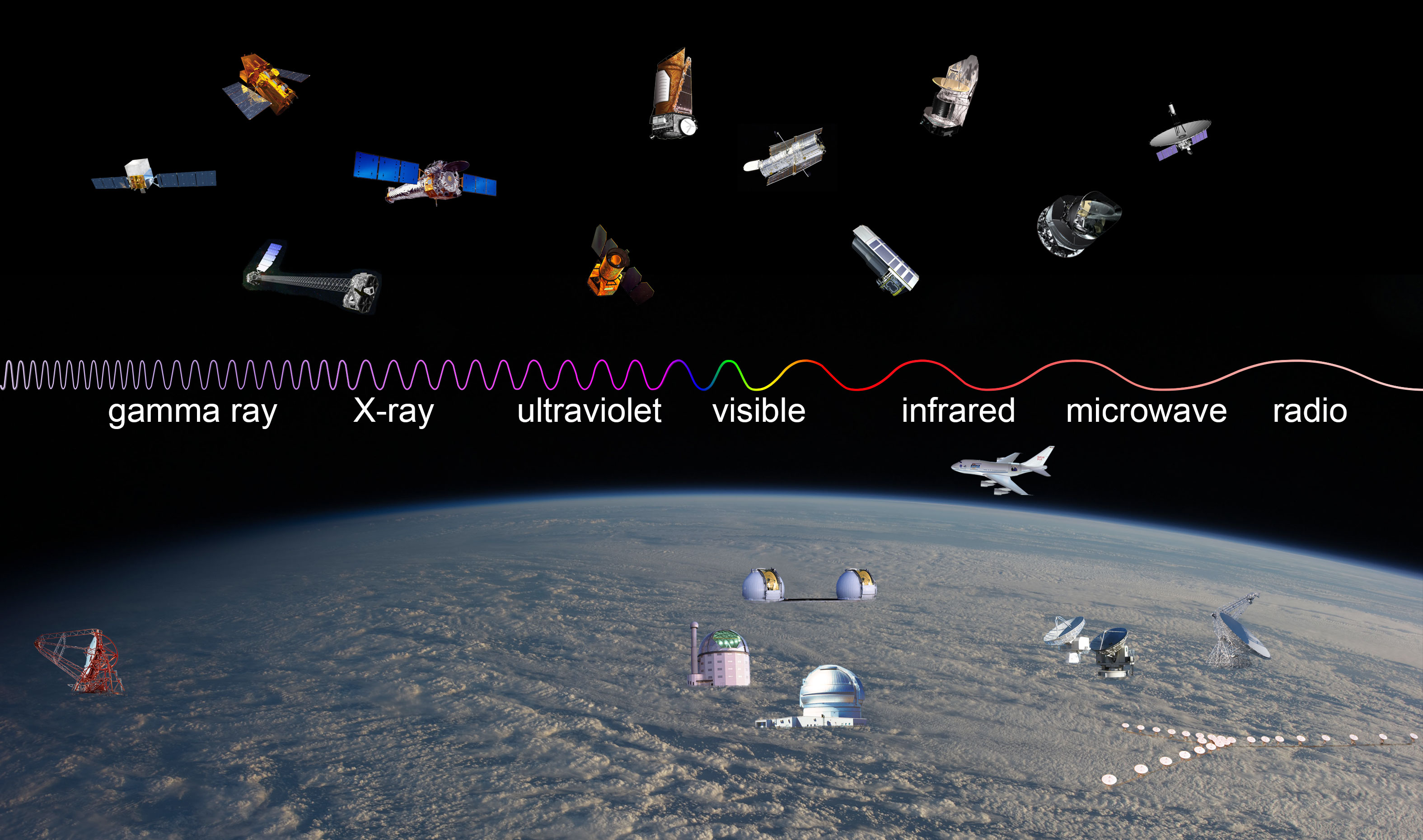
light. But the electromagnetic spectrum encompasses more than
just
optical light. It covers all energies of light, extending from
low-energy radio waves, to microwaves, to infrared, to optical light,
to ultraviolet,
to very high-energy X-rays and gamma rays.
In the next few paragraphs, we'll go into more detail
about line and continuum
emission, such as what mechanisms cause them, and what they can tell us
about
the light-emitting object. But first, to understand the ways
energy
is converted into light, we have to understand how the atom works.
Tell Me More About
Understanding
the Atom!
Line Emission
Instead of using our spectrometer
on a light bulb, what if we were to use it to
look at a tube of pure gas, like hydrogen? First, we need to heat the
hydrogen to a very high temperature, or give the atoms of hydrogen
energy by running an electric current through the tube. This would
cause
the gas to glow, or in other words, to emit radiation. If we looked at
the spectrum of
light
given off by the hydrogen gas with our spectroscope, instead of seeing
a continuum of colors, we would just see a few bright lines. Below we
see
the spectrum, the unique fingerprint of hydrogen.
These bright lines are called emission lines.
Remember how we
heated
the hydrogen to give the atoms energy? By doing that, we excited the electrons
in the atom. When the electrons fell back to their ground state, they
gave
off photons of light at hydrogen's characteristic energies. If we
altered the
amount or abundance of hydrogen gas we have, we could change the
intensity and brightness of the lines, because more photons
would be produced. But we couldn't change their color, because no
matter how
much or how little hydrogen gas was present, the pattern of lines would
be the same. Hydrogen's pattern of emission lines is unique to it. The
brightness of the emission lines can give us a great deal of
information about the abundance of hydrogen
present. This is particularly useful in a star, where
there are many elements mixed together.
Each element in the periodic table can appear in gaseous
form and will each
produce a series of bright emission lines unique to that element. The
spectrum of hydrogen will not look like the spectrum of helium, or
the
spectrum of carbon, or of any other element.
Hydrogen:

Helium:

Carbon:

We know that the continuum of the electromagnetic
spectrum extends from
low-energy radio waves, to microwaves,
to infrared, to optical light,
to ultraviolet, to X-rays and gamma rays. In the same way, hydrogen's
unique
spectrum extends over a range, as do the spectra of the other elements.
The above spectra are in the optical range of light. Line emission can
actually occur at any energy of light (i.e. visible, UV, etc.
) and with any type of atom. However, not all atoms have line
emission at all wavelengths.
The difference in energy between levels in the atom is not great enough
for the emission to be X-rays in
atoms of lighter elements, for example.
Different Graphical Representations of Spectra
The sample spectra above represent energy emission as lines, the amount
of
photons of light represented by the brightness and width of the line.
But we can also make a graphical representation of a spectrum. Instead
of the emission of a characteristic energy being shown as a line, it
can be shown as a peak on a graph. In this case, the height and width
of the peak show its intensity. One example of this is the very first
spectrum we looked at, which was the supernova remnant. The peaks and
bumps on the graph are
simply
a graphical representation of the emission lines of different elements.
Below is the spectrum of the Sun
at ultraviolet wavelengths. There are distinct lines (in the top
graph) and peaks (in the bottom one) and if you look at the X-axis,
you can see what energies they correspond to. For example, we know
that helium emits light at a wavelength of 304 angstroms, so if we see
a peak at that wavelength, we know that there is helium present.
Spectra and Astronomy
In a star, there are actually many elements present. We can
tell which ones are there by looking at the spectrum of the star.
The science of spectroscopy is quite sophisticated. From spectral
lines astronomers can determine not only the element, but the
temperature and density of that element in the star. The
lines can also tell us about the magnetic
field of the star. The width of
the line can tell us how fast the material is moving, giving us
information about stellar
wind. If the lines shift back and forth, it means
that the star may be orbiting another star - the spectrum will give the
information necessary to estimating the mass and size of the star system
and the companion star. If the lines grow and fade in
strength we can learn about the physical changes in the star.
Spectral information, particularly from energies of
light other than
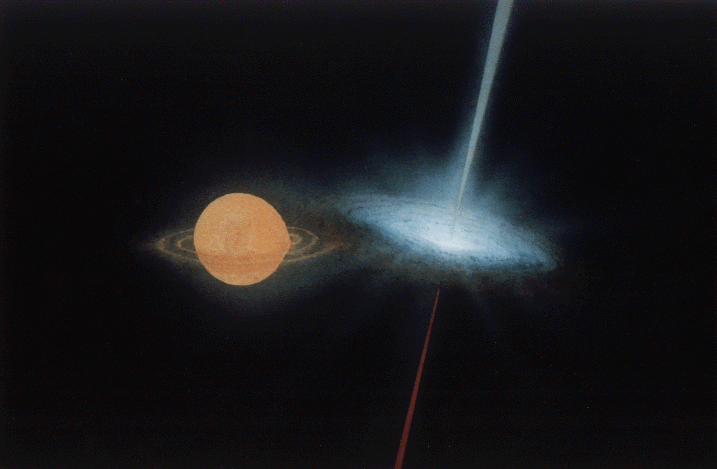
optical, can tell us about material around stars. This material may
have been pulled from a companion star by a black hole
or a neutron
star, where it will form an orbiting disk. Around a compact object
(black hole, neutron star), the material in this accretion disk
is heated to the point that it gives
off X-rays,
and the material eventually falls onto the black hole or neutron
star. It is by looking at the spectrum of X-rays being emitted by
that object and its surrounding disk that we can learn about the
nature
of these objects.
Continuum Emission
Just like visible light, with its range of energies
from red to blue, X-rays have a continuum, or a range of energies
associated with it. X-rays usually range in energy from around 0.5 keV
up to around 1000
keV.
Like line emission, continuum X-ray emission involves
charged particles.
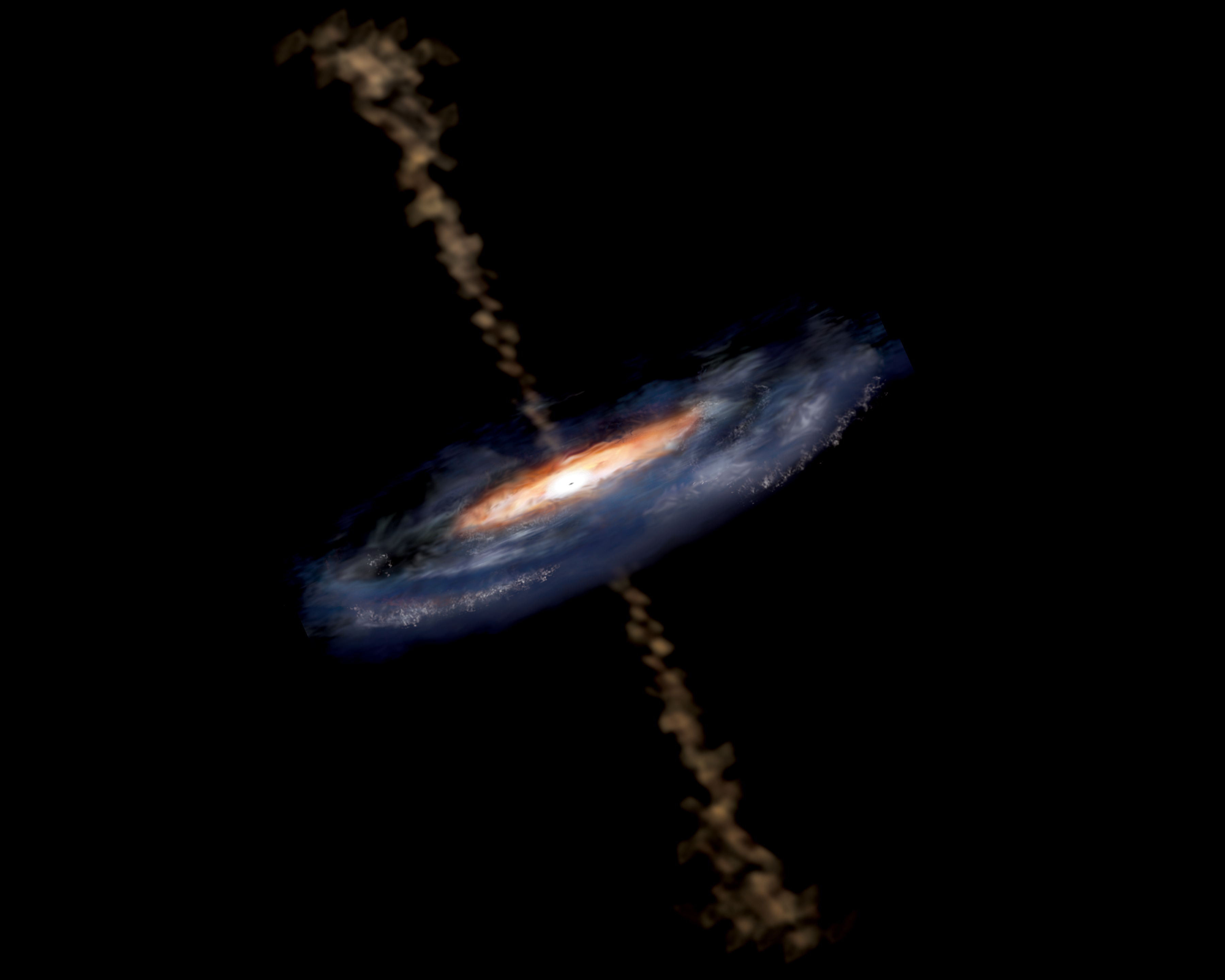
Continuum emission is a result of the acceleration of a population of
charged particles. All X-ray sources contain such particles. These
particles must be at least partially ionized, which means their
electrons need to
be unbound from their
nuclei to be free to zip around when they are heated to extreme
temperatures. For an electron to radiate X-rays, the gas containing the
electron must have extreme conditions, such as temperatures of millions
of degrees,
super-strong magnetic fields, or the electrons themselves must be
moving
at nearly the speed of
light. Extreme conditions can be found in disks of matter orbiting
black holes or in supernova remnants. Strong magnetic fields, like
those created in the wake of a supernova explosion, can also accelerate
fast-moving ions in spirals
around the field lines to the point of X-ray emission. Electrons can be
accelerated
to nearly the speed of light in the shockwave created by a supernova
explosion.
There are three mechanisms that will produce continuum
X-ray emission.
They are Synchrotron Radiation, Bremsstrahlung, and Compton
Scattering. Because the populations of electrons have a continuous
range of energies, and they can be accelerated through a range of
energies,
the radiation produced is continuous, and not at the discreet energies
of
line emission.

Courtesy of University
of Hertfordshire |
Synchrotron radiation is emitted when a
fast electron interacts with a magnetic field. A magnetic field in an
area where an
electron is traveling will cause the electron to change direction by
exerting a force on it perpendicular to the direction the electron is
moving.
As a result, the electron will be accelerated, causing it to radiate
electromagnetic energy. This is called magnetic bremsstrahlung or synchrotron
radiation (after radiation observed from particle accelerators by
that name). If the electrons and the
magnetic field are energetic enough, the emitted radiation can be in
the form
of X-rays.
Courtesy of University
of
Hertfordshire |
Bremsstrahlung occurs when an electron
passes close to a
positive ion, and the strong electric forces cause its trajectory to
change. The acceleration of the electron in this way causes it to
radiate electromagnetic energy. This radiation is called
bremsstrahlung, which in German translates literally to "braking
radiation." Thermal bremsstrahlung occurs in a hot gas, where many
electrons are stripped from their nuclei, leaving a population of
electrons and positive ions. If the gas is hot enough (millions of
degrees Celsius), this kind of radiation will primarily take the form
of X-rays.
Courtesy of University
of Hertfordshire |
Comptonization is when a photon collides
with an electron - the photon will either give up energy to or gain
energy from the electron, changing the electron's velocity as a result.
What are some examples of this in action?
Gas that is at about 1 million to 10 million degrees,
such as the gas
heated by a supernova explosion, produces most of its emission in
X-rays
from thermal bremsstrahlung. Gas can be heated to these temperatures by
the resulting shockwave
of a supernova explosion, or in an accretion
disk around a black hole or neutron star. Synchrotron
radiation can produce X-rays around supernova remnants (SNR), where the
magnetic fields are strong and ions have been accelerated by the shock
wave to high energies. X-rays produced by SNR require electrons with
energies of about 104 GeV each. You would have to heat an
electron to a temperature of about ten trillion degrees for it to have
this much energy!
Synchrotron radiation and Compton scattered
radiation are major components of the diffuse X-ray background and
emission from active galaxies.
Last Modified: October 2010
|