Imagine the Universe!
Imagine Home | Science |

Gamma-ray bursts: Solving the Mystery

Gamma-Ray Bursts: Introduction to a Mystery

Gamma-ray bursts are short-lived bursts of gamma-ray photons, the most energetic form of light, and are associated with a special type of supernovae, the explosions marking the deaths of especially massive stars.

Lasting anywhere from a few milliseconds to several minutes, gamma-ray bursts (GRBs) shine hundreds of times brighter than a typical supernova and about a million trillion times as bright as the Sun, making them briefly the brightest source of cosmic gamma-ray photons in the observable Universe. GRBs are detected roughly once per day from wholly random directions of the sky.

Until recently, GRBs were arguably the biggest mystery in high-energy astronomy. They were discovered serendipitously in the late 1960s by U.S. military satellites which were on the look out for Soviet nuclear testing in violation of the atmospheric nuclear test ban treaty. These satellites carried gamma ray detectors since a nuclear explosion produces gamma rays. [GRB history] As recently as the early 1990s, astronomers didn't even know if GRBs originated in our Milky Way Galaxy or incredibly far away, even at the edge of the observable Universe. (That is, they didn't know how far away GRBs were to within a factor of a few billion light years!) But now a slew of satellite observations, follow-up ground-based observations, and theoretical work have allowed astronomers to link GRBs to supernovae in distant galaxies.

Long or Short Duration?

Gamma-ray bursts are separated into two classes: long-duration bursts and short-duration bursts. Long duration ones last more than 2 seconds and short-duration ones last less than 2 seconds. However, this doesn't tell the whole story. That is because short duration bursts range from a few milliseconds to 2 seconds with an average duration time of about 0.3 seconds (300 milliseconds). The long-duration bursts last anywhere from 2 seconds to a few hundreds of seconds (several minutes) with an average duration time of about 30 seconds.

Astronomers think that long and short duration GRBs are created by fundamentally different physical properties. And whereas they now are fairly confident of what drives the long GRBs, there are only theories when it comes to what drives short-duration bursts. Here we will concern ourselves with long-duration bursts and address short-duration bursts later on.

GRBs: What Astronomers Now Know

Astronomers now know that long-duration gamma-ray bursts can originate near the farthest edges of the observable Universe. The stars linked to them are typically on the order of billions of light years away. This means the light from them traveling at "the speed of light" (about 186,000 miles per second or 300,000 kilometers per second) took that many years to reach us. The Earth itself is about 4 billion years old, so some GRBs occurred when our planet was still a fiery newborn, before the first microbes formed, even before the oceans had formed.

These stars are so far away that we don't actually see the light from them before they explode. We don't even see the galaxies these stars are in. They belong to an early generation of stars (maybe even the first generation of stars) in the Universe. Although such stars long ago died, only now is the light from their explosive deaths reaching us.

That's not to say astronomers have no idea what kind of stars produce gamma-ray bursts. Working with large amounts of data collected over the past 15 years with special instruments aboard satellites, such as NASA's Compton Gamma-Ray Observatory and the joint Italian-Dutch BeppoSAX, and using computer simulations, astronomers have developed a working model of the kind star that produces a GRB.

A Collapse and then a Spectacular Explosion

The theory describing how Gamma Ray Bursts originate is called the "collapsar" model. Dr. Stan Woosley of the University of California, Santa Cruz, and one of the architects of the model, coined this term because the model involves the collapse of the core of a special kind of star. This core collapse occurs while the outer layers of the star explode in an especially energetic supernova dubbed a "hypernova" by astronomers. (Here we'll refer to the theory as the "collapsar/hypernova" model to keep in mind both the core collapse and the supernova explosion.)

In looking for the stellar candidates capable of producing a hypernova, astronomers are confronted with the fact that gamma-ray bursts are so far away not even the most powerful telescopes can see the stars thought to be responsible for those observed so far.

But proponents of the collapsar/hypernova model think they have an idea. The kind of star is very heavy, very hot, and prone to episodic fits in which large amounts of material is ejected from it. Such a star is called a "Wolf-Rayet" star after two 19th Century French astronomers, Charles Wolf and Georges Rayet, who studied the first example.

Dissecting an Explosion

Wolf-Rayet stars are linked to hypernovae, which in turn are associated with gamma-ray bursts.

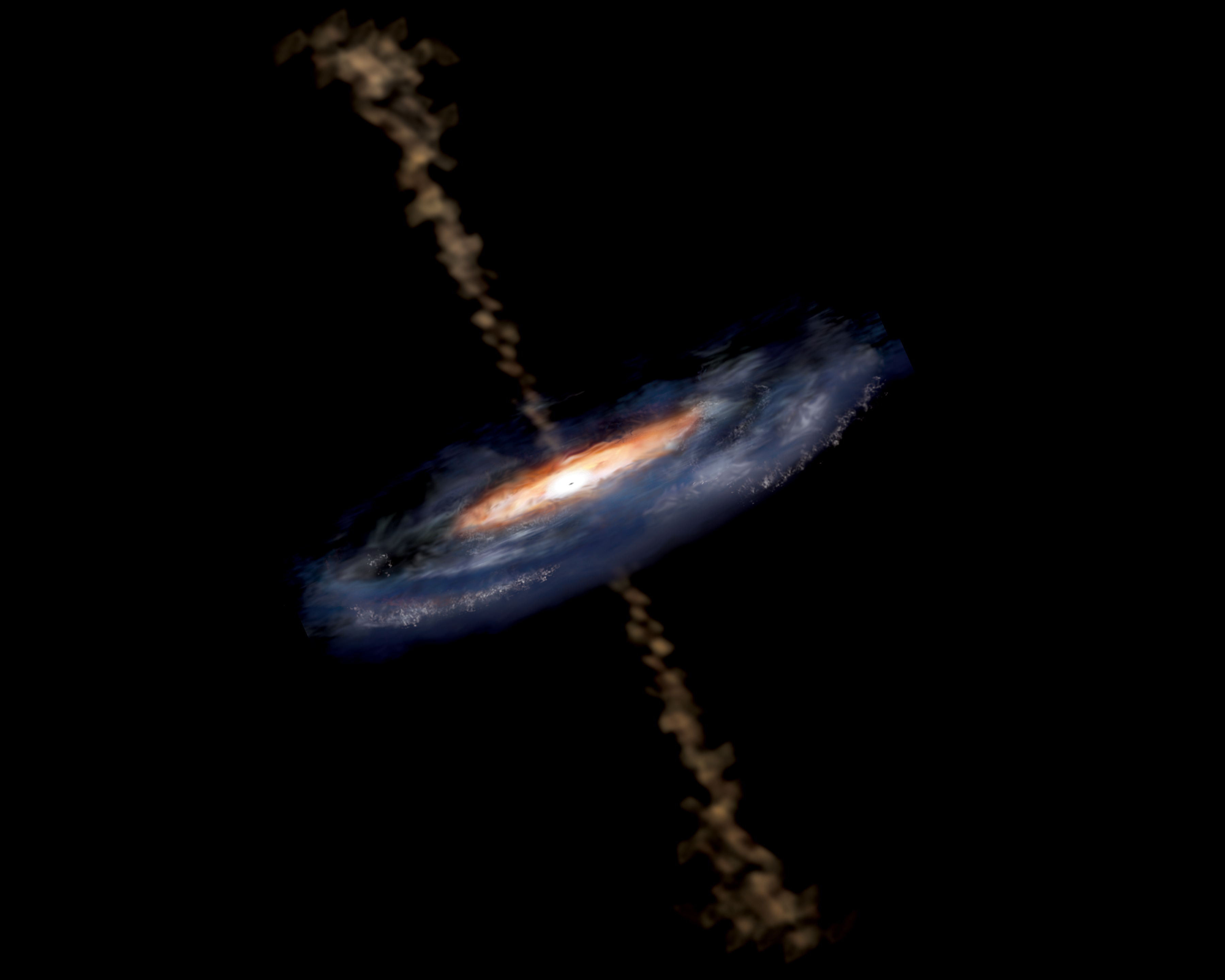
Although the exact picture has not been worked out, astronomers think the gamma-ray photons are probably produced inside the star. The explosion originates at the center of these massive stars. This explosion sends a blast wave moving through the star at speeds close to the speed of light. The gamma rays are created when the blast wave collides with stellar material still inside the star. These gamma rays burst out from the star's surface just ahead of the blast wave. Behind the gamma rays, the blast wave pushes the stellar material outward.

Erupting through the star surface, the blast wave of stellar material sweeps through space at nearly the speed of light, colliding with intervening gas and dust, producing additional emission of photons. These emissions are believed responsible for the "afterglow" of progressively less energetic photons, starting with X rays and then visible light and radio waves. (Whether additional gamma rays are also produced in this "afterglow" phase is still not settled, although some evidence indicates they are.) [Some Gamma-Ray Bursts Once Turned Off, Black Back Into Action"] The afterglow phase can last for days or even weeks. Under the collapsar model, we detect both the GRB and the afterglow when the Earth happens to lie along or very near the axis of the blast. In general, there are many more GRBs than are detected simply because we are not favorably aligned to see them [Many gamma-ray bursts go undetected".]

Chasing the Explosion

Not until astronomers were able to make afterglow observations could they develop a working hypothesis on what caused gamma-ray bursts. And while the Compton Gamma Ray Observatory's Burst And Transient Source Experiment (BATSE) detector catalogued 2,704 GRBs during the observatory's nine year lifetime (1991 - 2000), it was not equipped to make afterglow observations. Furthermore, it had not been possible to get either a ground or space-based telescope look up quickly enough to a spot where a GRB had been detected.

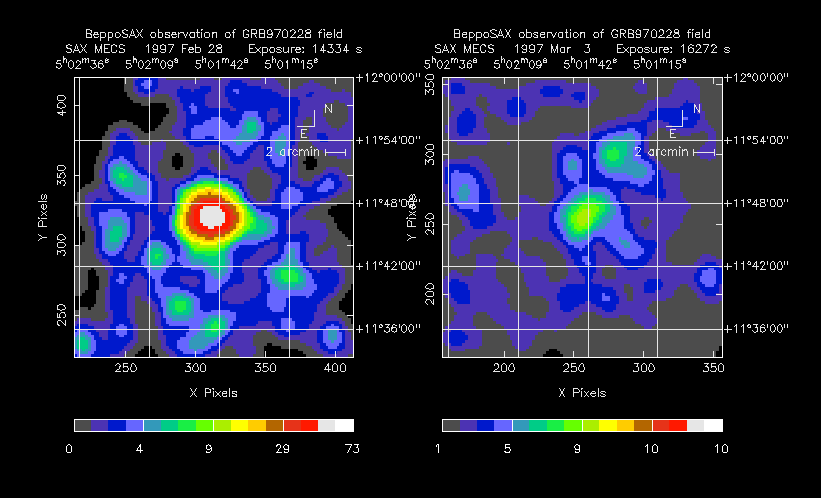
As a result, the first afterglow observation did not come until the BeppoSAX satellite. BeppoSAX was an Italian satellite which was equipped with both a gamma ray and an X-ray detector. It spotted the X-ray afterglow signature associated with the gamma-ray burst on February 28, 1997 (dubbed GRB 970228 using the standard naming convention). Up until that time, it simply wasn't possibly to get either a ground or space-based telescope to look quickly enough at a spot where a GRB had been detected.

Today a worldwide network called the Gamma-ray burst Coordinates Network (GCN) coordinates space-based observations and ground-based follow-through observations of GRB afterglow. NASA satellites include the High Energy Transient Explorer (HETE) operated by the Massachusetts Institute of Technology and the Rossi X-ray Timing Explorer (RXTE). The European Space Agency operates Integral, a new gamma-ray mission launched in 2002. And there is the Interplanetary Gamma-Ray Burst Timing Network (IPN), which consists of a group of space probes with gamma-ray detectors at different locations in the Solar System.

By timing the arrival of gamma-ray photons at each satellite, the location of the burst can be "triangulated." The GCN sends out automatic notices by email to astronomers worldwide, enabling both professional and amateur astronomers to make follow-up afterglow observations. ["Amateur astronomer locates powerful stellar explosion before the pros".]

GRB-Supernova Link: The Proof

Initial evidence that GRBs were linked to supernova came with the study of GRB 980425 in 1998. That burst was tentatively linked to a supernova called SN 1998bw located in a distant galaxy.

Definitive proof of the supernova link, at least in the case of those GRBs with an afterglow, came on March 29, 2003, when a relatively nearby burst, GRB 030329 produced an afterglow with the X-ray signature associated with oxygen heated to high temperatures. Such a light pattern occurs when the supernova blast wave excites oxygen atoms in the vicinity of the star. This constituted the "smoking gun," providing even more solid evidence than GRB 980425.

Lingering Mysteries

Although astronomers feel they have a good grasp on what triggers gamma-ray bursts with the collapsar/hypernova model, they know that many questions remain. To begin with, as we discussed at the outset, this model only deals with long-duration GRBs -- those lasting more --> -- than 2 seconds and having an average duration of about 30 seconds -- and that have a clearly defined burst followed by a clearly defined afterglow of progressively less energetic light. To date, no afterglow has ever been detected following a short duration GRBs, which makes fixing a distance to these bursts impossible. Furthermore, short-duration bursts appear to be triggered by a fundamentally different physical process, perhaps involving the merger of neutron stars. No one really knows. [Link to sidebar 4 "Short-duration gamma-ray bursts".] In addition, some GRBs are insufficiently energetic and fall into a category called "X-ray flashes" (XRFs). The BATSE instrument could not "see" these XRFs.

One suggestion for the existence of such short-duration GRBs and XRFs -- is that our viewing angle from Earth is slightly off the blast axis, so we're really looking at the very edge of the radiation "cone" created by these bursts. Yet this idea would seem to have trouble explaining the observation that some GRBs seem to "turn off" only to briefly "turn back on" at full power. Such findings blur the tidy distinction between GRBs and their less energetic afterglow assumed in the collapsar model.

In early 2004, NASA is planning to launch into orbit the Swift Gamma-Ray Burst Mission [LINK TO SWIFT HOME PAGE.] The Swift satellite will be NASA's most sophisticated GRB-detecting satellite ever with sensitivity five times better than the BATSE. It will also perform follow-through observations of the afterglow with an X-ray and a UV/optical telescopes. These will both automatically be pointed to a burst location within a minute a GRB is detected. The light from the afterglow will be analyzed to look for the characteristic "light curves" of a supernova explosion.

Once successfully in operation, the Swift mission will join HETE, RXTE, Integral, and the IPN array as the space-based side of the on-going, collaborative international effort by scientists on Earth to gain better understanding into gamma-ray bursts and what these titanic, distant explosions reveal about our awesome Universe.

If words seem to be missing from the articles, please read this.

Imagine the Universe! is a service of the High Energy Astrophysics Science Archive Research Center (HEASARC), Dr. Alan Smale (Director), within the Astrophysics Science Division (ASD) at NASA's Goddard Space Flight Center.

The Imagine Team
Acting Project Leader: Dr. Barbara Mattson
Project Leader (on leave): Dr. Jim Lochner
Curator: Meredith Gibb
Responsible NASA Official: Phil Newman
All material on this site has been created and updated between 1997-2012.
Last Updated: Tuesday, 08-Feb-2005 15:26:25 EST