What we know and what we don't know
We know what they look like in time
Perhaps the most striking feature of the time profiles of
gamma-ray bursts is
the diversity of their time structures. Some burst light curves are spiky with
large fluctuations on all time scales, while others show rather simple
structures with few peaks. However, some bursts are seen with both
characteristics present within the same burst! In a few cases, burst sources
have repeated their appearance. However, no persistent, strictly periodic
behavior has been seen from gamma-ray bursts.
The durations of gamma-ray bursts range from about 30 ms to over 1000 s.
However, the duration of a gamma-ray burst is difficult to quantify since it is
dependent upon the
sensitivity
and the time resolution of the experiment which observes the event. The
"tip of the iceberg" effect tends to cause weaker bursts to be
observed as shorter, since only the higher parts of the peak emission are
observable.
We know that they come from every direction in the sky

For a long time, astronomers thought that the source of a gamma-ray burst
would be in our Milky Way Galaxy. If the source was in our own Galaxy, it would
be easier to explain how it produced the amount of energy it does (the further
away it is, the more energy it would have to contain for us to still see it as
bright as we see it). But being in our own Galaxy would then cause the
distribution of gamma-ray burst locations (that is, how we see them spread out
in the sky) to be concentrated along the galactic plane. This would be so
because the galactic plane is where most of the
stars are located in
our Galaxy, and it was believed that a gamma-ray burst had to be related to
some stage of the life of a star.
However, this is not what we see! Thanks to data primarily from the BATSE
experiment on the Compton Gamma-Ray Observatory, we know that bursts occur
randomly all over the sky. This makes it very hard for scientists to figure out
what is causing the gamma-ray burst and where to look for the next burst...
after all, the whole sky is a very big place to try to watch all at once!
In fact, this is one of the biggest problems with gamma-ray bursts. Since
we never know where the next burst will come from, we can't bring all of the
different telescopes in the world (or in
orbit) to observe
the burst location and thus (hopefully) identify the object that emits the
flash of gamma-rays.
You might want to see a movie of the locations
of several hundred of the bursts that BATSE has detected.
We don't know what kinds of objects emit the radiation
In fact, we have absolutely no idea what kind, or kinds, of objects are
responsible for gamma-ray bursts! As mentioned above, astronomers first
thought that the events were probably related to an activity of a star in
some part of its life cycle. Then we saw enough bursts to understand that
our initial ideas had to be essentially wrong. Now, we just don't know.
But scientists are never at a loss for ideas!

|
Tell Me About Some Ideas on the Origins of Gamma-ray Bursts!
|
Two ideas, or theories, about what kinds of objects are responsible for
gamma-ray bursts that are being discussed these days are:
 |
Neutron stars in a big halo that surrounds the outside of the part of
our Galaxy that we can see with our eyes.
|
 |
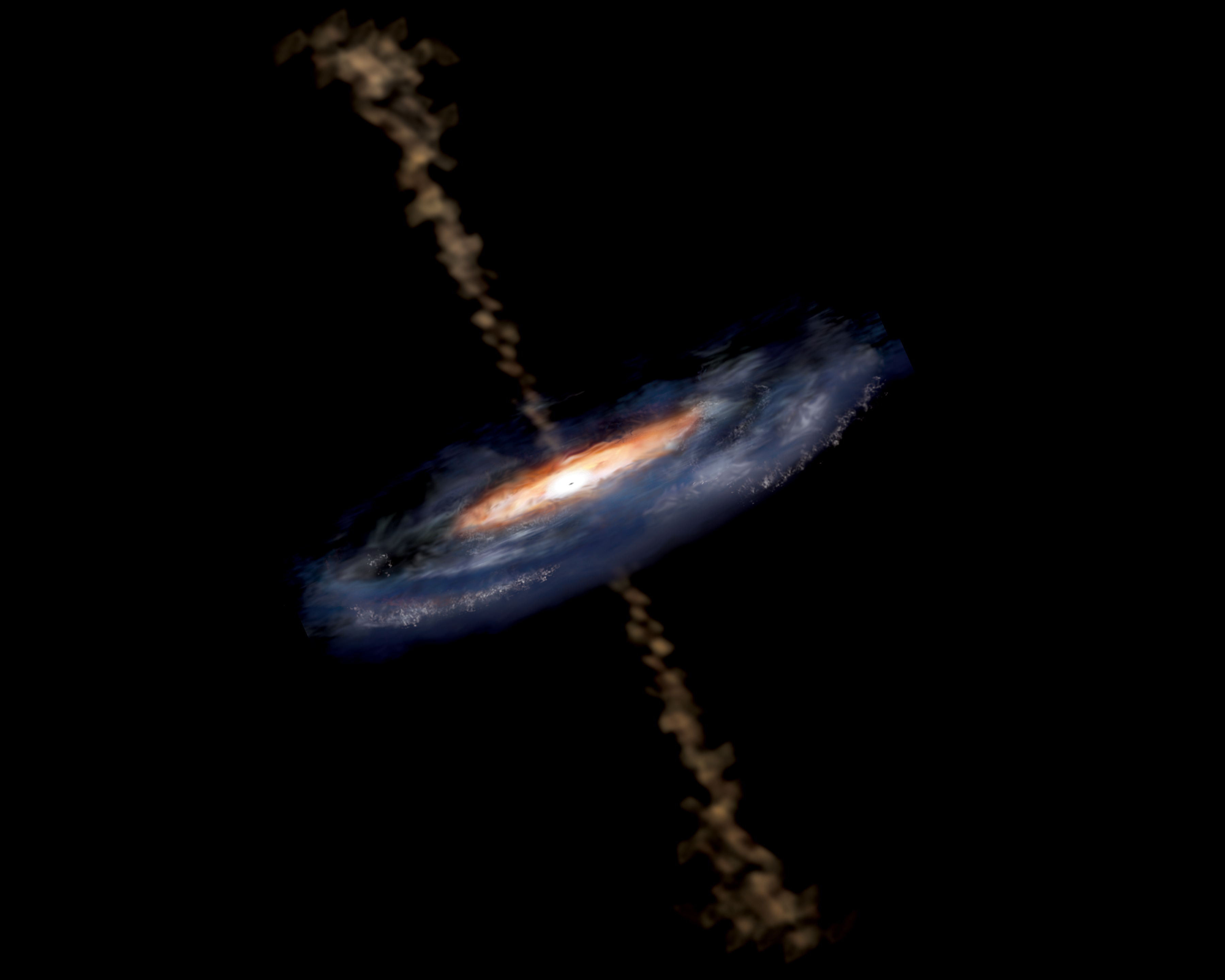
Some undefined type of very, very powerful object that is not
necessarily in our Galaxy in great abundance, but which can be found in
all galaxies in the Universe. |
One way we may find the answer to the question of what kind of objects are
responsible for gamma-ray bursts is to find what is called a 'counterpart' to
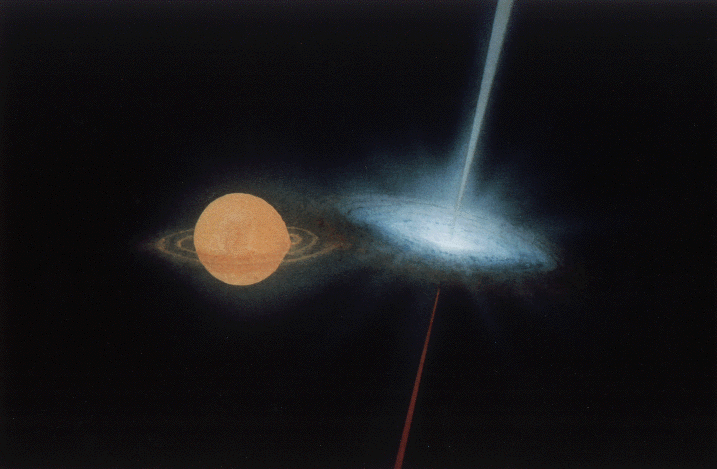
the burst. The 'counterpart' is an object which is connected to the object
that emits the gamma-ray burst in a close way, for example in a
binary system.
It is called the 'counterpart' because it is an object that we can use to
study the gamma-ray burst emitting object in an indirect way. Hopefully, we
can see the counterpart in another part of the
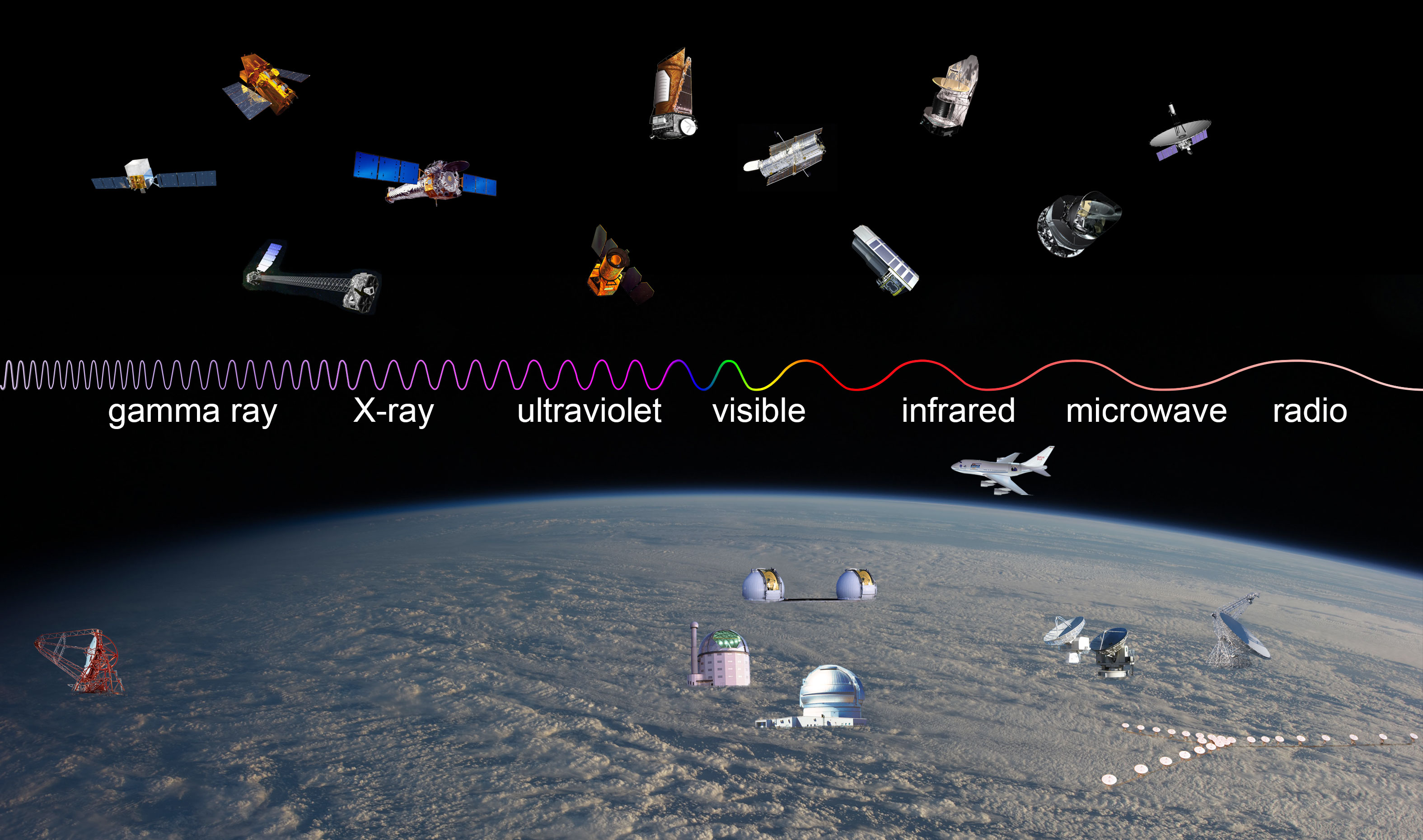
electromagnetic
spectrum. This would then allow us to
bring a whole range of science tools to bear on what is causing the gamma-ray
burst. These tools might include spectra, photometry, distance estimates,
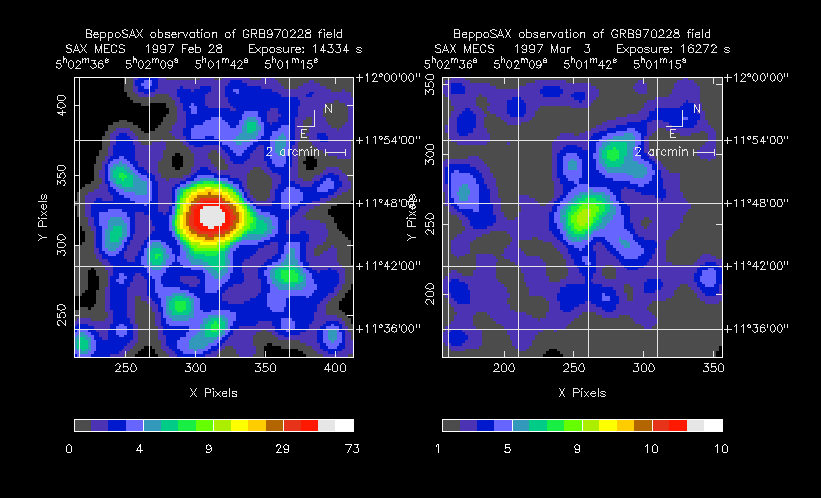
comparisons with other objects, and so on. Recently, such
counterpart
searches have paid off.
|