Active Galaxies and Quasars
A Monster in the Middle
Most large galaxies have
~1011 Mo of stars,
~109-10 Mo of interstellar gas, and ~1012
Mo of dark matter. But at least 5% of galaxies —
though it may be all of them — also have something else lurking
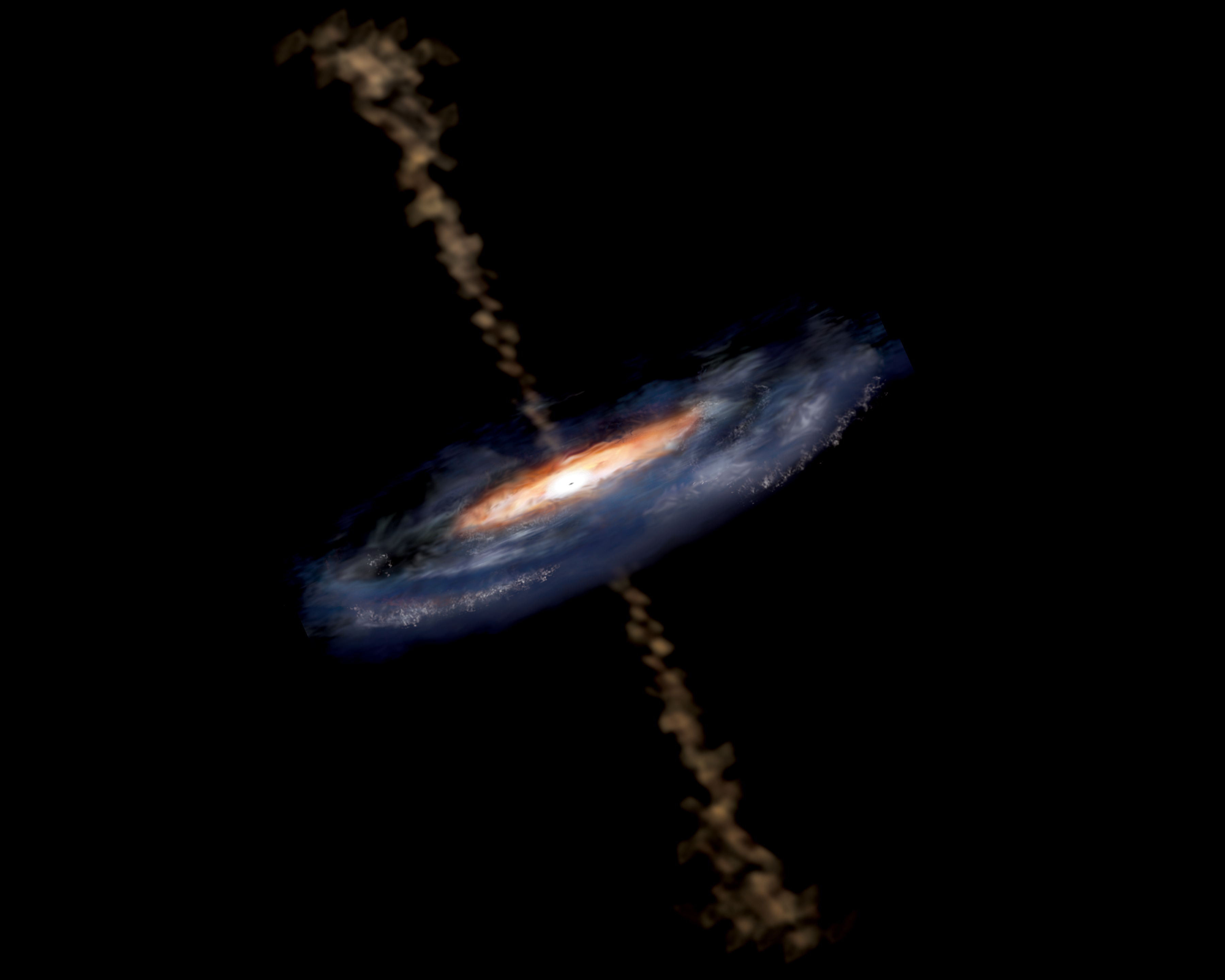
inside: a monster in the middle. This monster is a supermassive
black hole, which ejects tremendous amounts of energy from jets at its
top and bottom. How can this incredible objects be explained?
Long ago, when galaxies were young, the stars in the central
regions of the galaxies were very closely packed. Star collisions and
mergers occurred, giving rise to a single
massive black
hole (MBH) with perhaps 106 to 109 Mo.
Gas
from the galaxy's interstellar medium, from a cannibalized galaxy, or
from a
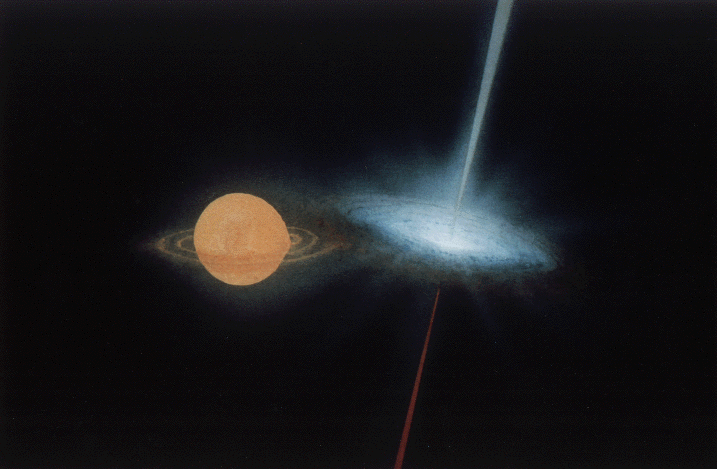
star that strays too close, falls onto the MBH. As in X-ray
binary star
systems, an
accretion
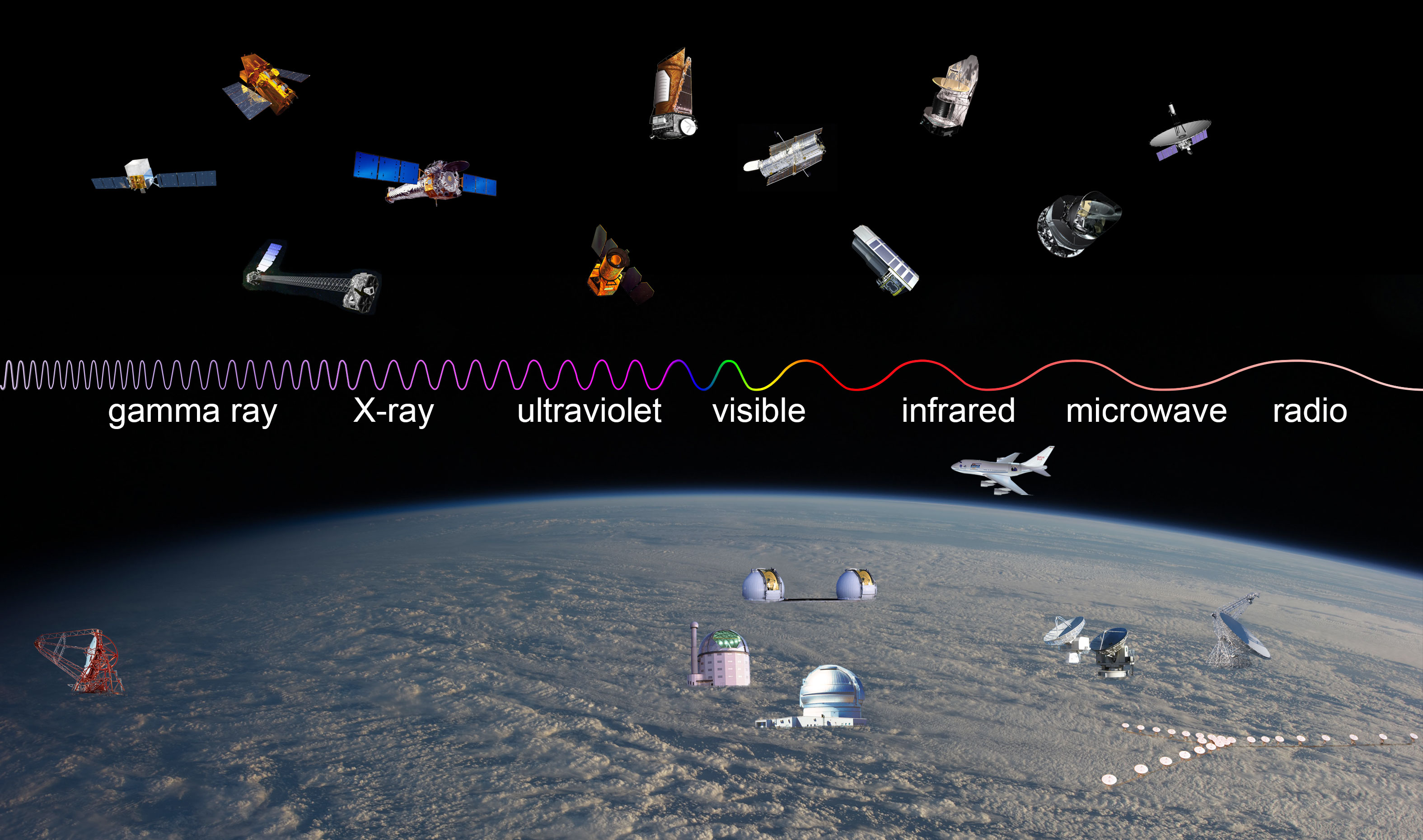
disk forms, emitting huge amounts of light across the
electromagnetic
spectrum
(infrared to
gamma rays). The MBH plus accretion
disk produces the phenomena seen in
active galactic
nuclei
(AGN). Below are optical and radio images of the active
galaxy NGC 4261. The central object, accretion disk and lobes are all
visible.

Ground-based and Hubble Space Telescope
images of the Active Galaxy NGC 4261
The different types of AGN are variations on this theme. Many
galaxies may have a quiet MBH that has not recently accreted gas.
Seyfert galaxies exhibit accretion onto a
moderate-mass MBH, while the more luminous quasi-stellar objects, like
quasars, exhibit accretion onto a high-mass MBH.
In approximately 10% of the AGN, the MBH + accretion disk somehow
produces narrow beams of
energetic particles and magnetic
fields, and eject them outward in opposite
directions away from the disk. These are the radio jets, which emerge at nearly
the speed of
light. Radio galaxies, quasars, and blazars are AGN with strong jets
that can
travel outward into large regions of intergalactic space. Many of the
apparent differences between types of AGN are due to our having
different
orientations with respect to the disk. With blazars and quasars, we
are looking down the jet. For Seyferts, we are viewing the jet
broadside.
Considerable uncertainties remain. Exactly how are jets produced
and
accelerated? Where do the clouds producing the broad emission lines
come from?
Can we empirically confirm that a MBH is actually present?

An artist's conception of an AGN
Seyferts
Consider NGC 4151, a spiral galaxy 15 Mpc away. Photographs by Carl Seyfert in the
1940s showed a bright point-like nucleus. Its spectrum is unusual: in addition to a
continuum and
absorption lines from normal stars, Seyfert galaxy nuclei have strong
emission lines. Some are commonly found lines,
such as hydrogen (e.g. the Balmer series H-alpha, H-beta lines). Others
are not as common, or even rare, like the lines for twice-ionized
oxygen, in which the oxygen atom has lost two of its electrons, and
whose formation requires extremely hot gas. The lines are broad,
requiring that the gas be Doppler
shifted in all directions up to ~20,000 km/s. The nuclei vary in
brightness on timescales of months, requiring them to be < 1 parsec
in size. The total luminosity
can be equivalent to 1010 Lo.
What is this bizarre object in the center of Seyfert's spiral
galaxies?
Later in the 1940s, astronomers
began scanning the skies with radio
telescopes. They found strange radio structures on opposite sides of
radio
galaxies, plus a tiny source of radio emission at the nucleus. The
nuclei of
these radio galaxies shoot out narrow beams of extremely energetic electrons
and
magnetic
fields, producing radio synchrotron radiation.
The radio components include: the compact core at the galaxy nucleus,
jets, lobes, and a hot spot where the jet slams into the interstellar medium.
Quasars
In the 1960s, some radio sources seemed to be associated with "stars,"
and
were called quasi-stellar radio
sources or quasars.
However, they had spectra similar
to Seyfert
galaxy nuclei. It became clear that they are Seyferts, and radio
galaxies where the nucleus out shines all of the stars by factors of 10
to 1,000. The
luminosity of quasars can reach 1012 Lo. They
also tend to be farther away than either Seyfert galaxies or blazars.
In the 1970-80s, findings include:
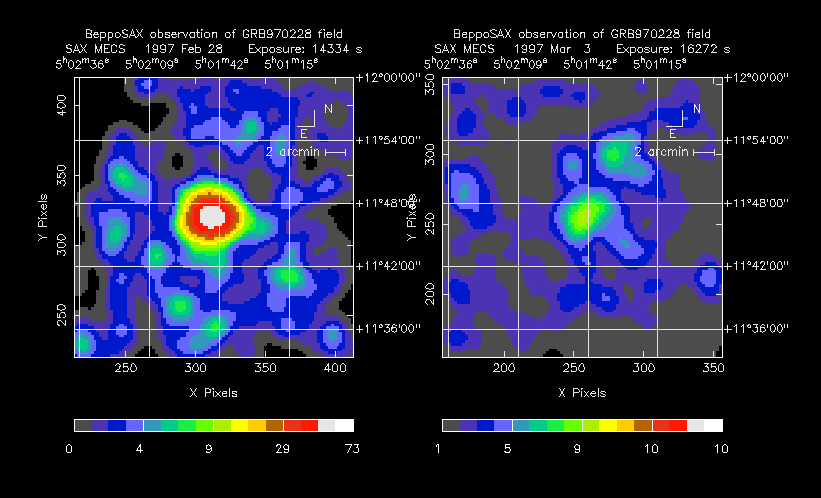
- X-ray satellite
telescopes found strong and very rapidly variable X-ray emission from
Seyferts and quasars. Timescales for these variations were as short as
days, hours, or even minutes.
- Rare BL Lac objects and blazars were discovered. These are radio
galaxies with jets pointing directly at us, ejected by the active
nucleus at velocities near the speed of
light.
- Optical
astronomers find thousands of faint distant quasars which are not
radio-loud. Strangely, there were many more quasars early in the Universe
than there are today.
- In 1993, the Compton Gamma-Ray
Observatory discovers incredibly intense gamma-rays from the jets of
some blazars: Stronger than X-ray, optical, radio emission combined.
Blazars
AGNs observed at high (>100 MeV) energies form a
subclass known as blazars, which is thought to be an AGN that has one
of its relativistic
jets pointed toward Earth so the emission we
observe is dominated by phenomena occurring in the jet region. Among
all AGNs,
blazars emit over the widest range of frequencies,
and have been detected
from radio to gamma-ray.
Specifically, to be classified as a blazar an AGN must be seen with
one
of the following properties:
- high radio-brightness accompanied by flatness of the radio
spectrum
- high optical polarization,
- strong optical variability on very short timescales (less than
few
days).
In the class of objects selected according to these criteria, there
appear to be two subgroups:
- Sources showing strong and broad emission
lines, such as those of quasars (called Flat Spectrum Radio Quasars)
- Sources showing a featureless optical spectrum (called BL Lac
objects).
There are additional important differences between these subclasses.
For example, blazars show different luminosity and redshift
distributions, and a different morphology of the extended radio
emission.
In its first year of operation, the Fermi Gamma-Ray Space Telescope detected 709
active galaxies, most of which are blazars. Of these, 300 are BL Lac
objects, nearly 300 are Flat Spectrum Radio Quasars (FSRQ), 41 are
other types of AGN, and 72 are of unknown types.
Last Updated: January 2011
|