The amount of energy a photon has can cause it to behave more like a
wave, or more like a particle. This is called the "wave-particle
duality" of light. It is important to understand that we are not talking
about a difference in what light is, but in how it behaves. Low energy
photons (such as radio photons) behave more like waves, while higher
energy photons (such as X-rays) behave more like particles.
The electromagnetic spectrum can be expressed in terms of energy,
wavelength or frequency. Each way of thinking about the EM spectrum is
related to the others in a precise mathematical way. Scientists represent wavelength and frequency by the Greek letters lambda (λ) and nu (ν). Using those symbols, the relationships between energy, wavelength and frequency can be written as:
wavelength equals the speed of light divided by the frequency
or
λ = c / ν
and
energy equals Planck's constant times the frequency
or
E = h × ν
Where:
λ is the wavelength
ν is the frequency
E is the energy
c is the speed of light, c = 299,792,458 m/s (186,212 miles/second)
h is Planck's constant, h = 6.626 x 10⁻²⁷erg-seconds
Both the speed of light and Planck's constant are constant they
never change in value.
Conversion between wavelength, frequency and energy for the
electromagnetic spectrum. (Click image for a larger version.)
While all light across the electromagnetic spectrum is fundamentally
the same thing, the way that astronomers observe light depends on the
portion of the spectrum they wish to study.
For example, different detectors are senstive to different wavelenths
of light. In addition, not all light can get through the Earth's
atmosphere, so for some wavelengths we have to use telescopes
aboard satellites. Even the way we collect the light can change
depending on the wavelength. Astronomers must have a number of different telescopes and detectors
to study the light from celestial objects across the electromagnetic spectrum.
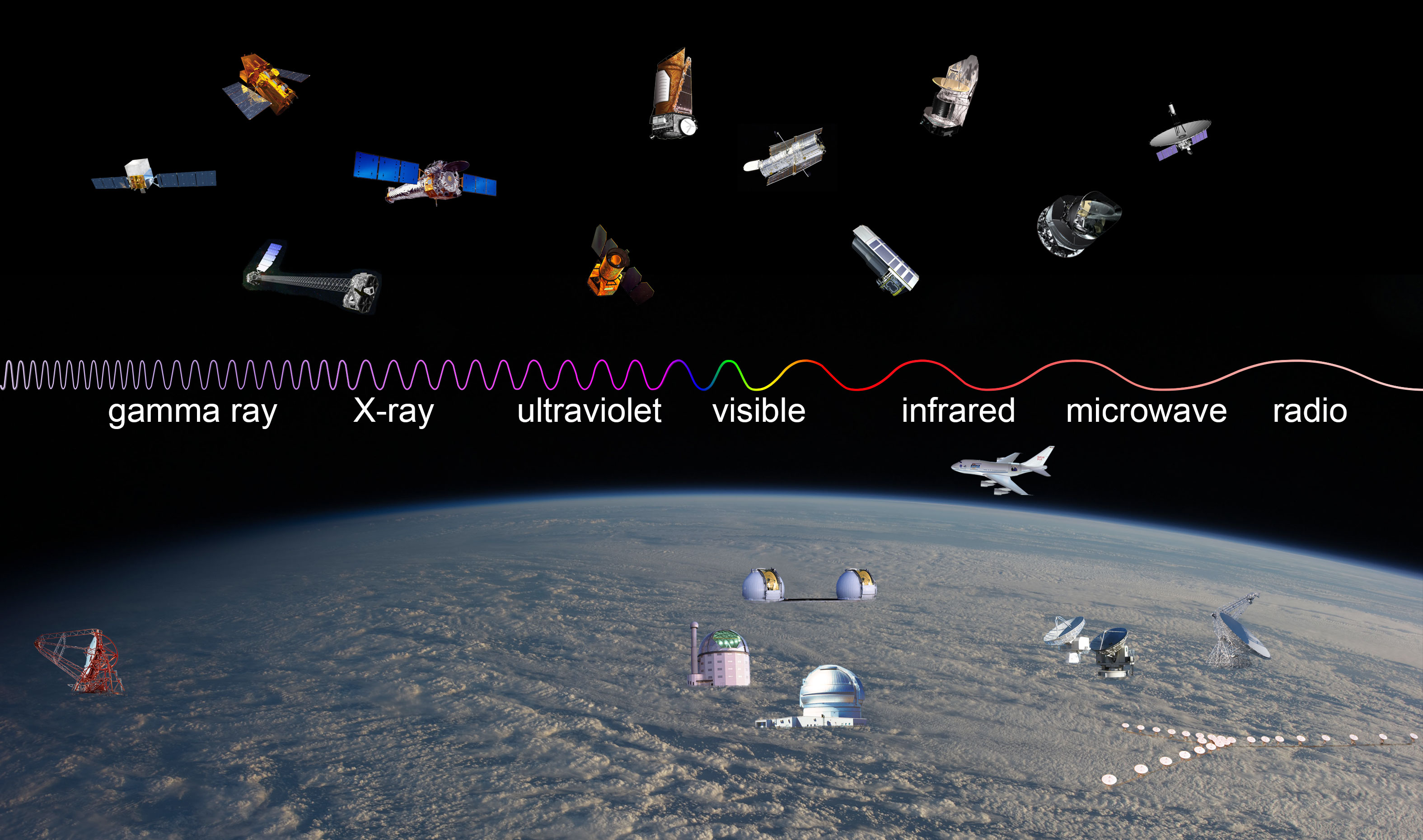
A sample of telescopes (operating as of
February 2013) operating at wavelengths across the electromagnetic
spectrum. Several of these observatories observe more than one band
of the EM spectrum, and those are placed within the band of their
primary instrument(s).
The represented observatories are: HESS,
Fermi and Swift for gamma-ray, NuSTAR and Chandra for X-ray, GALEX
for ultraviolet, Kepler, Hubble, Keck (I and II), SALT, and Gemini
(South) for visible, Spitzer, Herschel, and Sofia for infrared,
Planck and CARMA for microwave, Spektr-R, Greenbank, and VLA for
radio. Click
here to see this image with the observatories labeled.
Do you have a question, problem or comment about this web site? Please let us know.
External links contain material that we found to be relevant. However they're not maintained by us and the content may have changed. If you find any external links that contain inappropriate material, please let us know!