Gamma-ray Astronomy
History of Gamma-ray Astronomy
Long before experiments could detect
gamma rays
emitted by cosmic sources,
scientists had known that the universe should be producing these
photons. Work
by Feenberg and Primakoff in 1948, Hayakawa and Hutchinson in 1952, and
Morrison in 1958 had led scientists to believe that a number
of different processes occurring in the universe would result in
gamma-ray emission. These processes included cosmic ray interactions
with interstellar gas,
supernova
explosions and interactions of energetic electrons with
magnetic
fields. However, it was not until the 1960s that scientists were
able to detect these emissions.
Gamma rays coming from space are mostly absorbed by Earth's
atmosphere. So gamma-ray
astronomy
could not develop until it was possible to get the detectors above all or
most of the atmosphere,
using balloons or spacecraft. The first gamma-ray
telescope was carried into
orbitsatellite
in 1961, and picked up fewer than 100 cosmic
gamma-ray photons. These appeared to come from all directions in the
universe, implying some sort of uniform "gamma-ray
background." This background would be expected from the interaction of cosmic rays
(very energetic charged particles in space) with gas found between the
stars.
Significant gamma-ray emission from our Galaxy was first
detected in 1967 by the the gamma-ray detector aboard the
OSO-3
satellite. It detected 621 events attributable to cosmic gamma rays.
However, the field of gamma-ray astronomy took great leaps forward with the
SAS-2 (1972)
and the
COS-B
(1975-1982) satellites. These two satellites provided an exciting
view into the high-energy universe, sometimes called the "violent"
universe, because the type of events in space that produce gamma rays
tend to be explosions and high-speed collisions. The data from the
satellites confirmed the earlier findings of the gamma-ray background,
produced the first detailed map of the sky at gamma-ray
wavelengths,
and detected a number of point sources, where the sources of radiation
were very concentrated and emanated from a small area. However, the
poor
resolution
of the instruments made it impossible to identify most of these
point sources with individual stars or stellar systems.
Perhaps the most spectacular discovery in gamma-ray astronomy came in
the late 1960s and early 1970s from a collection of defense satellites that
were put into orbit for a reason completely unrelated to astronomy
reasearch. Detectors on board the
Vela satellite
series were designed to detect flashes of gamma rays from nuclear
bomb blasts. They began to record bursts of gamma rays, not from the
vicinity of Earth, but from deep space. These gamma-ray bursts (GRBs)
can last for fractions of a second to minutes, popping off like cosmic
flashbulbs from unexpected directions, flickering, and then fading
after briefly dominating the gamma-ray sky. Studied for over 25 years
with instruments on board a variety of satellites and space probes, including
Soviet Venera
spacecraft and the
Pioneer Venus
Orbiter, the sources of these enigmatic high-energy flashes for a while remained a mystery. In one of the most intense debates in modern astrophysics, some scientists claimed that the bursts originate in a
halo of
neutron stars which surround our Galaxy while others argued that
their origins are far beyond the Galaxy, at
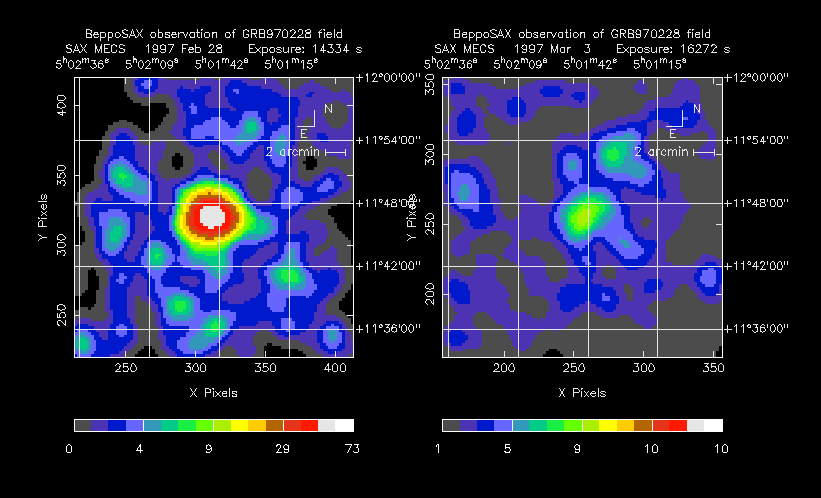
cosmological distances. This was settled in 1996 when the BeppoSax satellite and the Hubble Space Telescope pinpointed the location of a gamma-ray burst in distant galaxy.
In 1977, NASA announced plans to build a "great observatory" for
gamma-ray astronomy. The
Compton Gamma-Ray
Observatory (CGRO) was designed to take advantage of the major
advances in detector technology during the 1980s, and was launched in 1991. The satellite carried
four major
experiments which greatly improved the spatial and temporal
resolution of gamma-ray observations. The CGRO provided large amounts
of data which have been used to improve our understanding of
the high-energy processes in our Universe. CGRO was de-orbited in June
2000 as a result of the failure of one of its stabilizing gyroscopes.
In November 2004, NASA launched the
Swift satellite. Its primary
mission is to detect and locate GRBs as quickly as possible, report the
position of the burst, then follow up with other observations of that
location in the X-ray, UV and visual spectra. On April 13, 2010, NASA's
Swift satellite recorded its 500th GRB.
To continue the study of the universe in the gamma-ray spectrum,
Swift currently operates in conjunction with the
Fermi Gamma-Ray Space
Telescope, launched in 2008. Fermi, originally called GLAST (Gamma-ray
Large Area Space Telescope), also studies GRBs, as well as blazars,
neutron stars, gamma-ray background radiation, supernova remnants, dark
matter and more.
Last Modified: October 2010
|