Welcome to the World of Multiwavelength Astronomy!
Until the 20th century, astronomers learned virtually all they knew
about sources in the sky from only the tiny fraction of electromagnetic
radiation that is
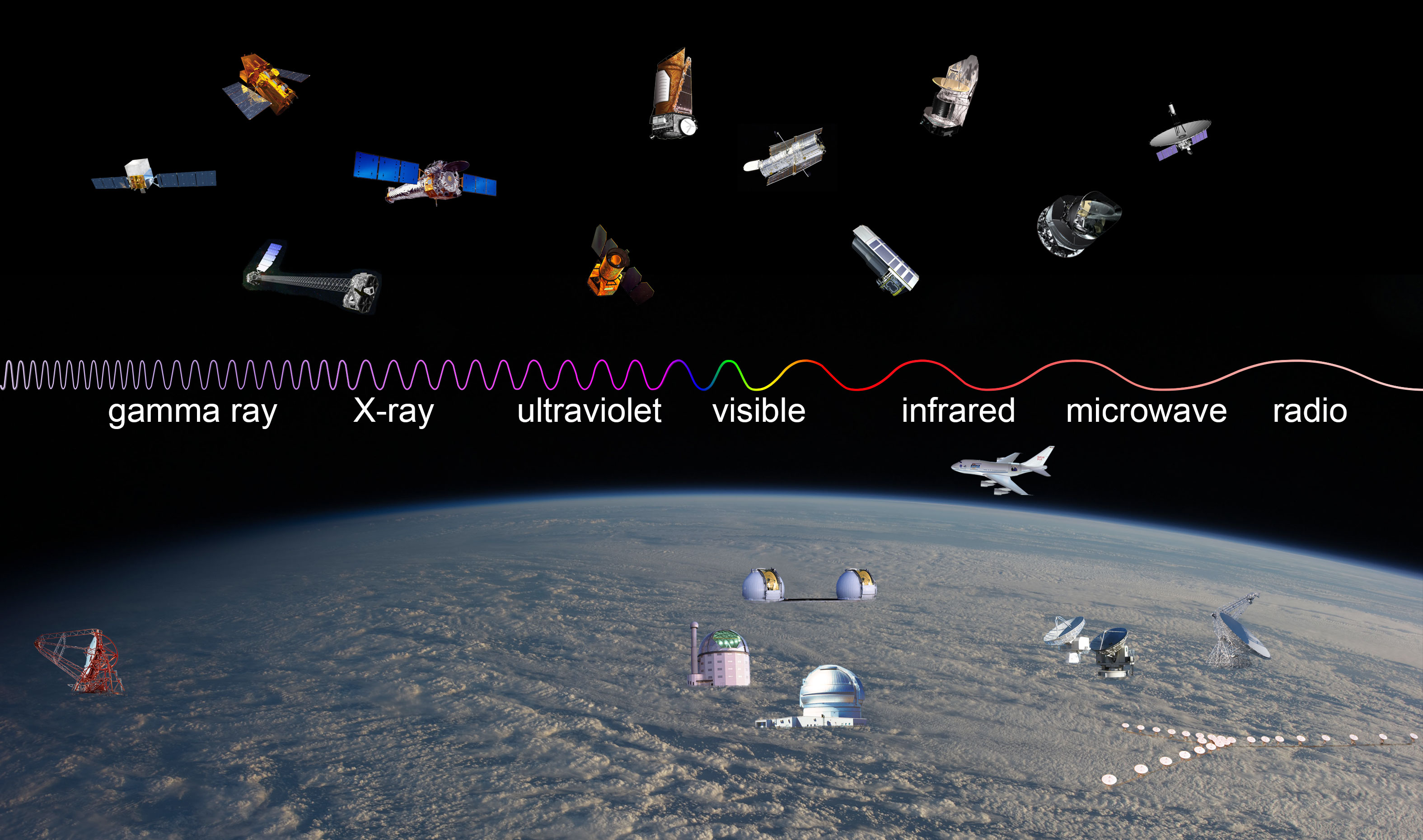
visible to the eye. However, as astronomers have discovered how to
collect radiation
outside this part of the spectrum, they have been able to learn much
more about the universe. Many objects reveal different aspects
of their composition and behavior at different wavelengths.
Other objects are completely invisible at one wavelength, yet are
clearly visible at another.
This section explains a little about what is revealed by observing
at each wavelength, and includes an example image of the Crab Nebula
to illustrate how one source varies its appearance from one wavelength
to
another.
The Crab Nebula
In July of 1054 A.D., Chinese astronomers and members of the Anasazi
tribe — native Americans living in present-day Arizona —
recorded the appearance of a new star. Although it was visible for only a few
months, it was bright enough to be seen even during the day.
At the same location in the sky, near the constellation Taurus, the
19th
Century French comet hunter Charles Messier recorded a fuzzy ball of
light that looked similar to a comet, but did not move across the sky.
Messier recorded the nebula, called the Crab for its supposedly
crab-like
appearance, as the first object in his catalog. For this reason,
it is sometimes
called M1. It was also one of the first sources of X-rays
identified in the early 1960s, when the first X-ray astronomy
observations were made, and at that time it acquired another name, Tau
X-1.
Scientists now know that the Crab Nebula is the remains of a star
that
suffered a supernova
explosion. The core of the star collapsed and formed
a neutron
star, which released a tremendous amount of energy, sufficient to
blast
the surface layers of the star into space. The expelled gases have
formed the nebula, which is still expanding. When the central star collapsed,
its
magnetic
fields and rotation collapsed with it, so the neutron star is now a
rapidly rotating object with an intense magnetic field near its
surface. The
strobe effect of the rotating star generates pulses observed at radio,
optical,
and X-ray wavelengths. Thus we see flashes from the neutron star each
time one
of the magnetic
poles is pointed toward Earth. Such a neutron star is
called a pulsar.
Radio Astronomy

What the Crab Nebula looks like in the radio can be seen in this
image made at the National Radio Astronomy Observatory (©
1992). This image shows two
distinctive physical features. First, the colored regions (in this
false-colored image, blue is less intense, green is a little more
intense, yellow more intense still, and red the most intense) represent
the radio emission that comes from unbound electrons spiraling around
inside the nebula. Second, the pulsar at the heart of the Crab Nebula
generates pulses at radio frequencies roughly 60 times a second. In
this image, the pulsar's flashes are blurred together (since the image
was "exposed" for much longer than 1/60 s) and it appears as the bright
white spot near the middle of the nebula.
Optical Astronomy

The Crab Nebula in the visible spectrum (photograph courtesy of the
Anglo-Australian Observatory) shows two distinct features: a reddish
web of filaments at the outer edges of the nebula and a bluish core.
The blue core of the nebula is from electrons within the nebula being deflected and
accelerated by the magnetic field of the central neutron star. The
radiation appears blue because this process emits more light in the
shorter (bluer) wavelength portion of the visible spectrum than in the
longer (redder) wavelength portion.
The filaments surrounding the edges of the nebula are what is left
of the
original outer layers of the star. The red color comes from emission of
hydrogen.
Blown off the star by the supernova,
the filaments are still expanding outward into space, away from the
central star. Scientists can measure this expansion by comparing
pictures taken several years apart and tracing the motion of these
filaments. Extrapolating backward in time shows that the filaments
first started expanding away from the center around 1040-1070 A.D. This
agrees well with the 1054 A.D. supernova explosion.
Ultraviolet Astronomy

The Crab Nebula in the ultraviolet
(or UV) shows a nebula that is slightly
larger than what is seen in X-rays (photograph from the Ultraviolet
Imaging
Telescope). This reveals that cooler electrons (responsible for the UV
emission) extend out beyond the hot electrons near the central pulsar.
This supports the theory that the central pulsar is responsible for
energizing the electrons.
X-ray Astronomy

The Crab Nebula in X-rays reveals a condensed core near the central
neutron
star. The central star is seen to pulse in X-rays, just like it does at
radio and optical wavelengths.
The Crab Nebula appears smaller and more condensed in X-rays because
the
electrons that are primarily responsible for the X-ray emission exist
only near the central pulsar. Scientists believe the strong magnetic
field near the surface of the neutron star "heats up" the electrons in
it. These "hot" electrons are responsible for the X-ray emission.
Last Modified: November 2010
|