Pulsars
A pulsar is a neutron
star that emits beams of radiation that sweep through Earth's line
of sight. Like a black hole,
it is an endpoint to stellar evolution. The "pulses" of high-energy radiation
we see from a pulsar are due to a misalignment of the neutron star's
rotation axis and its magnetic axis. Pulsars seem to pulse from our
perspective because the rotation of the neutron star
causes the beam of radiation generated within the magnetic field to
sweep in
and out of our line of sight with a regular period, somewhat like the
beam of light from a lighthouse. The stream of light is, in reality,
continuous, but to a distant observer, it seems to wink on and off at
regular intervals.

A diagram of a pulsar showing its rotation axis,
its magnetic axis, and its magnetic field.
Observations of Pulsars
Neutron stars have very intense magnetic
fields, about a trillion times stronger than Earth's own field.
However, the axis of the magnetic field is not
aligned with the neutron star's rotation axis.
The combination of this strong magnetic field and the rapid rotation
of the neutron star produces extremely powerful electric fields, with
electric potential in excess of 1 trillion volts. To put this power
into perspective: A single cubic meter of the magnetic field in the
Crab pulsar contains more energy than humans have been able to
generate, to date.
Electrons
are accelerated to high velocities by these strong electric
fields. These high-energy electrons produce radiation (light) in
two
ways. In the first, they act as a coherent plasma, and the electrons work together to
produce radio emission
by a process whose details are still being researched; and secondly,
the electrons interact individually with photons or the magnetic field to produce
high-energy emissions in
optical, X-ray and gamma-ray
wavelengths. The exact locations where the
radiation is produced are uncertain, and they may be different for
different
types of radiation, but they must occur somewhere above the magnetic
poles.
External viewers see pulses of radiation whenever this region above
the the magnetic pole is visible. Because of the rotation of the
pulsar, the pulses thus appear much
as a distant observer sees a the light from a lighthouse, which seems
to blink as its beam
rotates. The pulses come at the same rate as the rotation of the
neutron star, and, thus, appear periodic.
Gamma-ray Pulsars
Pulsars are the original gamma-ray astronomy point sources. A few years
after the discovery of pulsars by radio astronomers, the Crab and Vela
pulsars were detected at gamma-ray energies. Pulsars accelerate
particles
to tremendous energies in their magnetospheres.
These particles are ultimately responsible for
the gamma-ray emission seen from pulsars.
By the end of 2010 there were about 1800 pulsars known through
radio detections, but only about 70 had been detected in the gamma-rays. Gamma-ray telescopes
preferentially detect young, nearby pulsars. These pulsars
tend to have large magnetic fields and to be spinning rapidly. It is
the loss of the pulsar's spin energy which eventually appears as
radiation across the electromagnetic
spectrum,
including gamma-rays. Both observations and models indicate that
pulsars eventually lose the ability to emit gamma-rays as the pulsar
slowly takes longer and longer to rotate.

|
The folded light
curves of some of the known gamma-ray pulsars compared to other
energies. Explaining the differences is an important part of pulsar
studies.
|
Gamma-ray astronomers measure both the pulsar's light curve
and how the gamma-ray energy
is distributed within the light curve. In this way, detailed models of
how this light is created can be compared to observations to better
understand pulsars. In addition, comparison of the
gamma-ray energy to energy emitted at other wavelengths
gives scientists
other important clues to how the radiation is created. Hopefully,
future gamma-ray instruments will greatly increase the number of
detected sources and allow astronomers greater insight into these
fascinating objects.
|
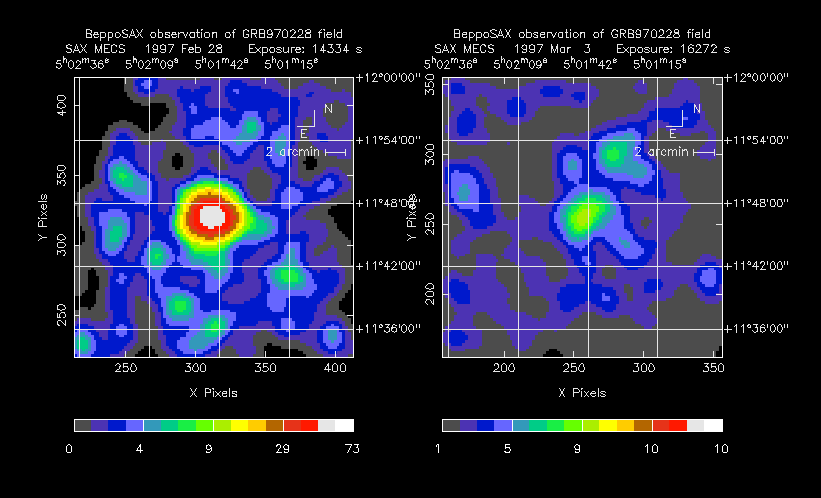
The pulsed emission
from Geminga, formerly an unidentified gamma-ray source. In the bottom
set of images, the region of the sky containing Geminga is shown as a
function of pulsar phase.
|
X-ray Pulsars
Although all pulsars are neutron stars, not all neutron stars are
pulsars, and not all pulsars shine in the
same way. X-ray pulsars in particular illustrate several ways in
which pulsar emission can originate:
Magnetospheric Emission: Like gamma-ray pulsars, X-ray
pulsars can
be produced when high-energy electrons interact in the magnetic field
regions above the neutron star's magnetic poles. Pulsars seen this way,
whether in the radio, optical, X-ray, or gamma-ray, are often referred
to as "spin-powered pulsars," because the ultimate source of energy
comes from the neutron star's rotation. The eventual loss of rotational
energy
results in a slowing of the pulsar spin period.
Cooling Neutron Stars: When a neutron star is first formed
in a supernova,
its surface is extremely hot (more than 1 million
degrees). Over time, the surface cools. While the surface is still
hot enough, it can be seen with X-ray telescopes. If some parts of
the neutron star are hotter than others, such as the magnetic poles,
then pulses of thermal X-rays from the neutron star surface can be
seen as the hot spots pass through our line of sight. Some pulsars,
including Geminga (see above), show both thermal and magnetospheric
pulses.
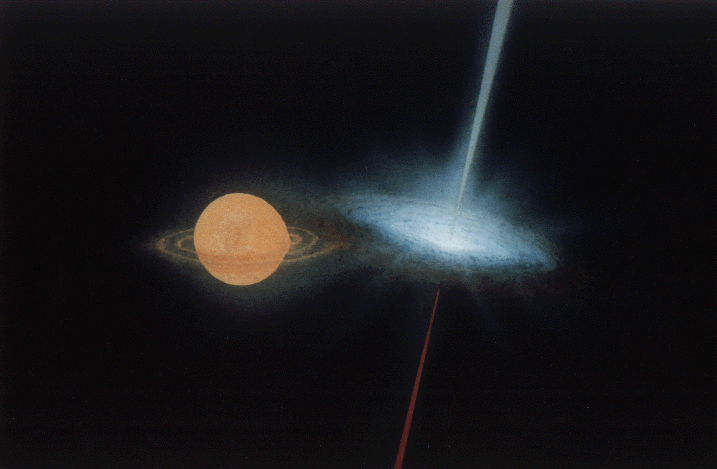
Accretion: If a neutron star is in a binary system with a
normal star, the powerful gravitational field of the neutron star can
pull material from the surface of the normal star. As this material
spirals around the neutron star, it is funneled by the magnetic field
toward the neutron star magnetic poles. In the process, the material
is heated until it becomes hot enough to radiate X-rays. As the
neutron star spins, these hot regions pass through the line of sight
from Earth and X-ray telescopes see these as X-ray
pulsars. Because the gravitational pull on the material is the basic
source of energy for this emission, these are often called
"accretion-powered pulsars."
Last Modified: January 2011
|