Supernovae

|
| "After" and "Before" pictures of
Supernova 1987A |
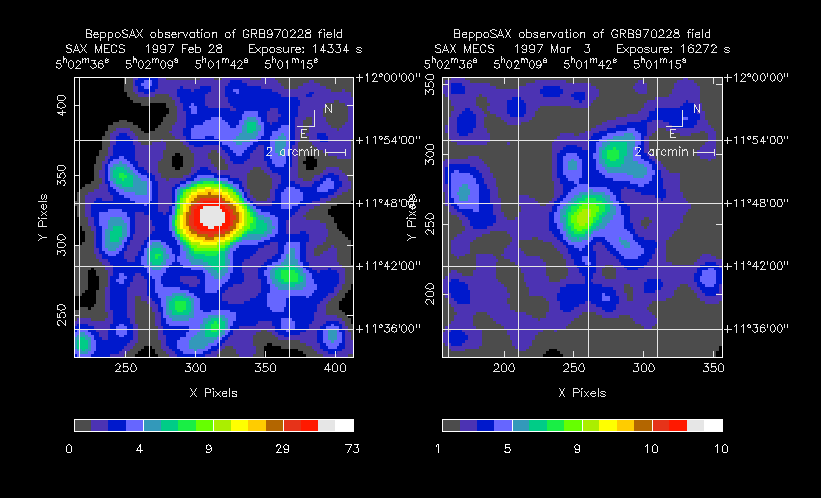
The above two photographs are of the same part of the sky. The photo
on the left was taken in 1987 during the supernova
explosion of SN 1987A, while
the right hand photo was taken beforehand. Supernovae are one of the
most energetic explosions in nature, equivalent to the power in a 1028
megaton bomb
(i.e., a few octillion nuclear warheads).
Types of Supernovae
Supernovae are divided into two basic physical types:
| Type Ia. |
These result from some binary star
systems in which a carbon-oxygen white dwarf
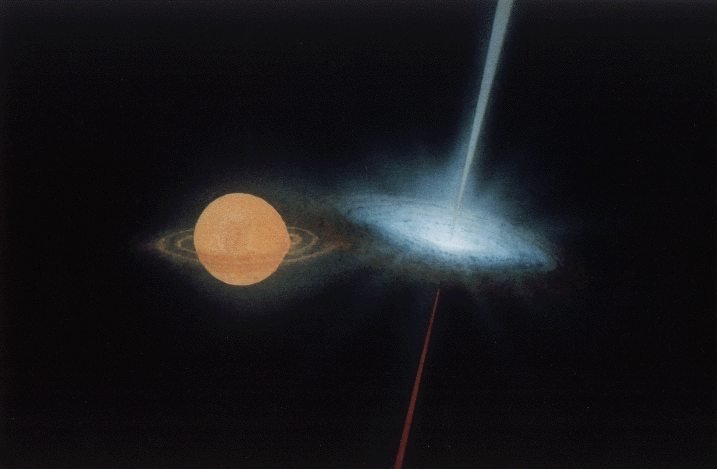
is accreting matter from a companion. (What kind of companion star is
best suited to produce Type Ia supernovae is hotly debated.) In a
popular scenario, so much mass piles up on the white dwarf that its
core reaches a critical density of 2 x 10⁹ g/cm3.
This is enough to result in an uncontrolled fusion of carbon and
oxygen, thus detonating the star.
|
| Type II. |
These supernovae occur at the end of a massive star's
lifetime, when its nuclear fuel is exhausted and it is no longer
supported by the release of nuclear energy. If the star's iron core is
massive enough, it will collapse and become a supernova.
|
However, these types of supernovae were originally
classified based on the existence of hydrogen spectral
lines: Type Ia spectra do not show hydrogen lines, while Type II
spectra do.
In general this observational classification agrees with the
physical
classification outlined above, because massive stars have atmospheres
that are made of mostly hydrogen, while white dwarf stars are
bare. However, if
the original star was so
massive that its strong stellar
wind had already blown off the hydrogen from its atmosphere by the
time of the explosion, then it too will not show hydrogen spectral
lines.
These supernovae are often called Type Ib supernovae, despite really
being part of the Type II class of supernovae. Looking at
this discrepancy between our modern classification, which is based on a
true
difference in how supernovae explode, and the historical
classification, which is based on early observations, one can see
how classifications
in science can change over time as we better understand the natural
world.
What causes a star to blow up?
Gravity
gives the supernova its energy. For Type II supernovae, mass flows into
the core by the continued formation of iron from nuclear
fusion. Once the core has gained so much mass that it cannot
withstand its own weight, the core implodes.
This implosion can usually be brought to a halt by neutrons,
the only things in nature that can stop such a gravitational
collapse. Even neutrons sometimes fail depending on the mass of the
star's core. When the collapse is abruptly stopped by the neutrons,
matter bounces off the hard iron core, thus turning the implosion into
an explosion.
For a Type Ia supernova, the energy comes from the runaway fusion of
carbon and oxygen in the core of a white dwarf.
Where does the core go?
When the core is less massive than about 5 solar masses,
the neutrons are successful in halting the collapse of the star
creating a neutron star.
Neutron stars can sometimes be observed as pulsars or X-ray
binaries.
When the core is more massive (Mcore > ~ 5 solar
masses), nothing
in the known universe is
able to stop the core collapse, so the core
completely falls into itself, creating a black hole,
an object so dense that
even light cannot
escape its gravitational grasp.
To understand the phenomenon of core collapse better, consider an
analogy to a rocket escaping Earth's gravity. According to Newton's
law of gravity, the energy it takes to completely separate two
things is given by:
E = G M m / r
where G is the Gravitational constant, M is
the mass of Earth, m is the mass of the rocket and r is the
distance between them (the radius of Earth). When the rocket is shot
off at a given velocity v,
its energy is:
E = 1/2 m v2
For the rocket to escape the Earth's gravitational field, this
energy must be as least as great as the gravitational energy described
in the first equation. Thus, to determine if the rocket will completely
break free from the Earth's grasp, we set the two equations equal to
one another and solve for v:
v = ( 2 G M / r )1/2
This result is called the escape velocity. For the Earth, the
escape velocity is 11 km/sec.
Next imagine a star's central core in the role of the Earth in the
above analogy. Consider what would happen if during the core collapse,
the central core became so dense (i.e., the radius became very
small while its mass stays the same) that something would have to
travel faster than light to escape. Whenever this phenomenon occurs (i.e.,
Mcore > ~ 5 solar masses), the supernova creates a black
hole
from the core of the original star. Now the escape velocity is greater
than the
speed of light, which is 300,000 km/sec.
Where does most of the star go?
The core is only the very small center of an extremely large star that
for many millions of years had been making many (but not all) of the elements
that we find here on Earth. When a star's core collapses, an enormous
blast wave is created with the energy of about 1028 mega-tons.
This blast wave plows the star's atmosphere into interstellar space,
propelling the elements created in the explosion outward as the star
becomes a supernova remnant.
Are we made of stardust?
Many of the more common elements were made through nuclear
fusion in the cores of stars, but many of the rarer elements were
not. Because
nuclear fusion
reactions that make elements heavier than iron require more energy than
they give off, such reactions do not occur under stable conditions in
typical stars. On the other hand, supernovae are not stable, so
they can make these heavy elements beyond iron.
In addition to making elements, supernovae scatter the elements
that are made by
both the star and supernova out into the interstellar medium.
These are the elements that make up stars, planets and everything on
Earth, including our bodies.
How often do supernovae occur?
Although many supernovae have been seen in nearby galaxies,
supernova explosions are relatively rare events in our own galaxy,
happening once a century or so on average. The last nearby supernova
explosion occurred in 1680,
It was thought to be just a normal star at the time, but it caused a
discrepancy in the observer's star catalogue, which historians finally
resolved 300 years later, after the supernova remnant (Cassiopeia A)
was discovered and its age estimated. Before 1680, the two most recent
supernova explosions were observed by the great astronomers
Tycho Brahe
and Johannes Kepler
in 1572 and 1604 respectively.
In 1987, there was a supernova explosion in the Large Magellanic
Cloud, a companion galaxy to the Milky Way. Supernova 1987A, which is
shown at the top of the page, is close enough to continuously observe
as it changes over time, thus greatly expanding astronomers'
understanding of this fascinating phenomenon.
More information
A good book written for the non-scientist is:
The Supernova Story, by Laurence A. Marschall, ©1988,
Plenum Press, ISBN:0306429551.
Last Modified: January 2011
|