X-ray Transients

|
This is an X-ray image of a ROSAT
observation of a portion of the Andromeda Galaxy. The source shown
in the circle is RX J0045.4+4154, a recently discovered recurrent
X-ray transient.
|
A rocket-borne experiment in April 1967 found an
intense X-ray source in Centaurus. This source had not been detected a
year or so before, and observations after April showed a steady decline
in the source luminosity
until it completely disappeared in late September. The source was named
Centaurus X-2, and the word "transient" was associated with its
behavior. Two years later, in 1969, another source was seen in the Vela 5B
satellite data that exhibited similar "not there, then there, then not
there" behavior. By mid-1973, enough sources had been discovered with
similar characteristics, that a new class of sources, the X-ray
transients, was firmly entrenched in X-ray astronomy.
The precise definition of an X-ray transient has
undergone significant evolution since the early 1970s, primarily
because of ever-increasing sensitivity
of X-ray telescopes and detectors. Originally, the definition was
highly based on obserations, and included the following criteria:
- A transient had to have a
rapid rise time (the time it takes to reach its peak luminosity) of
less than a week, and gradual decline of approximately 1 to 8 weeks
- The ratio of maximum X-ray flux to minimum flux had
to be 1,000:1 or more
- The source could not reappear on time scales less
than two years
Today, the definition is much less restrictive. Now a source
is defined as a transient if it has periods of enhanced X-ray emission
that typically last longer than a week, but that are not representative
of the usual observed emission from the source. Recurrences can be
periodic or aperiodic, but there is no obvious correlation between
recurrence time and the luminosity amplitude of the outburst.

|
The ten-year light curve
of the transient source V0332+53 as seen by the Vela 5B all-sky
monitor. The source became very bright in 1973, and was not seen again
until 1983.
|
X-ray transients seem to divide themselves naturally
into two classes: those associated with high-mass X-ray binaries and
those associated with low-mass X-ray binaries. The high-mass X-ray
binaries contain a neutron star
or black hole
paired with a
massive star (usually more than five times the mass of our sun). Often,
the stellar companion is a Be star,
which sometimes sheds material
from its equatorial region. In
these systems, the transient event is characterized by having
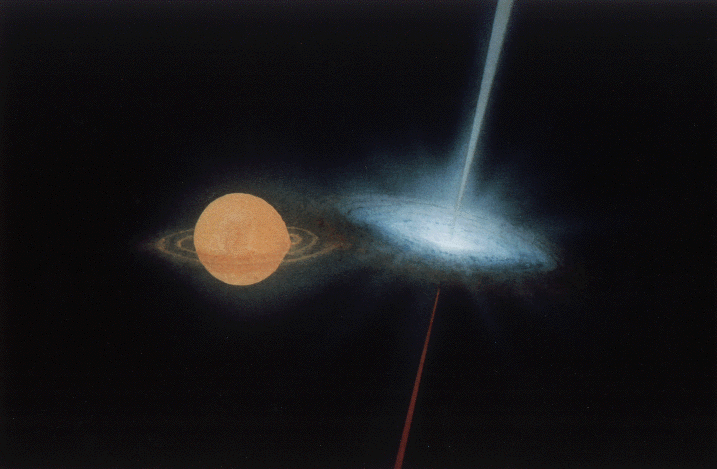
more higher energy X-rays in the spectrum. The low-mass X-ray binaries contain a
neutron star or black hole orbiting around a cooler, low-mass star.
These transient events often generate more lower-energy X-rays.
How do they do it?
It is believed that sudden profound changes in the the accretion
rate of the neutron star (or black hole) in the binary system lies at
the heart of the transient behavior. The question, then, is why the
sudden change takes place. For some stars, we have fairly conclusive
evidence of the reasons, but for others, we are not yet sure.
For a binary to be a bright X-ray emitter, there must
be some source of material that the neutron star can accrete. In
high-mass X-ray binaries, a companion Be star provides a well-known
potential source of the material for the neutron star. Be stars are
known to possess a circumstellar envelope that is strongly concentrated
in the equatorial plane. Furthermore, these stars are known to eject
large blobs of material from their equatorial region suddenly,
probably because these stars rotate so quickly that they are
near their break-up point.
Winds
from the normal star can also provide material,
especially for the more massive binaries. Changes in the wind density or
velocity can then lead to a neutron star being able (or unable) to
accrete the material due to the existence of a centrifugal barrier
around a rapidly rotating neutron
star. This barrier arises from the interaction of the neutron star's
magnetic field, which directs material to the neutron star, and the
material in the wind. The magnetic field rotates at the same rate as
the spinning neutron star. If the accretion rate is
small enough, the size of the magnetic field grows. If the magnetic
field is large enough, then the velocity at the edge of the field is
larger than the orbital velocity of material in the wind, and the
material cannot enter the magnetic field. Hence, accretion onto the
neutron star is cut off
and the X-ray production is turned off. X-ray production can be
turned back on if the wind velocity or density increases, shrinking
the size of the magnetic field. Thus, while the wind is persistent, the
X-ray production can turn on and off, creating a large change in source
luminosity.
What is happening to change the accretion rate in a
low-mass system is not nearly so clear. But we know that something must
be changing the accretion rate. It could be that accretion occurs only
during a small part of the binary orbit, when one star enters inside the
Roche lobe
of the other star. If these systems
have extremely long orbital periods so that this does not happen very
often, it could make the source look like a transient. Or perhaps the
binary orbit is precessing, and only during a certain phase of the
long-period precession do all the right conditions occur that would
lead to significant accretion. The most popular model for low-mass binary
transients is the creation of an instability in the accretion
disk. In essence, it is thought that material can
accumulate "quietly" in the disk for some time until there is enough
material for a thermal instability to take over and enhance the rate of
accretion onto the compact object.
Last Modified: October 2010
|