X-ray astronomy puts Einstein to the test
From tracing the way
light
bends around a
neutron star
to detecting the effects of a
black hole
tugging on space itself,
X-ray
astronomy
is uniquely suited to testing and observing predictions of
general relativity,
Albert Einstein's
landmark 1915 theory of
gravitation.
Thus far, Einstein's predictions are passing with flying colors. But
will Einstein have the last word on gravity? X-ray astronomers hope to
subject general
relativity
to even greater
scrutiny by traveling (albeit virtually) to where gravity is at its
extreme and the effects of general relativity most pronounced: the
innermost regions of black holes and neutron stars. The payoff will be a
greater understanding of the dominant force in the large-scale
universe
and, perhaps, a unified theory of the fundamental forces of nature
– the central goal of physics today.
In a mere 40 years, the field of X-ray astronomy has witnessed nearly
a billion-fold improvement in telescope
sensitivity
since June 18,
1962, when a sounding rocket laden with a payload of research equipment
discovered the first celestial X-ray source.
"We have come a long way, from the first inkling that a black hole
– Cygnus X-1 – was in hand," said Jean Swank of
NASA
Goddard Space Flight Center, Project Scientist for NASA's
Rossi X-ray Timing Explorer.
"Now we can reasonably hope to map spacetime close to the invisible
abyss of gravity."
General relativity defines gravity as a result of
mass
distorting both space and time – a four-dimensional concept called
spacetime. Nowhere is this more evident than in the regions around a
black hole and neutron star – two examples of mass at extreme
density, and thus sources of extreme gravity in a small area.
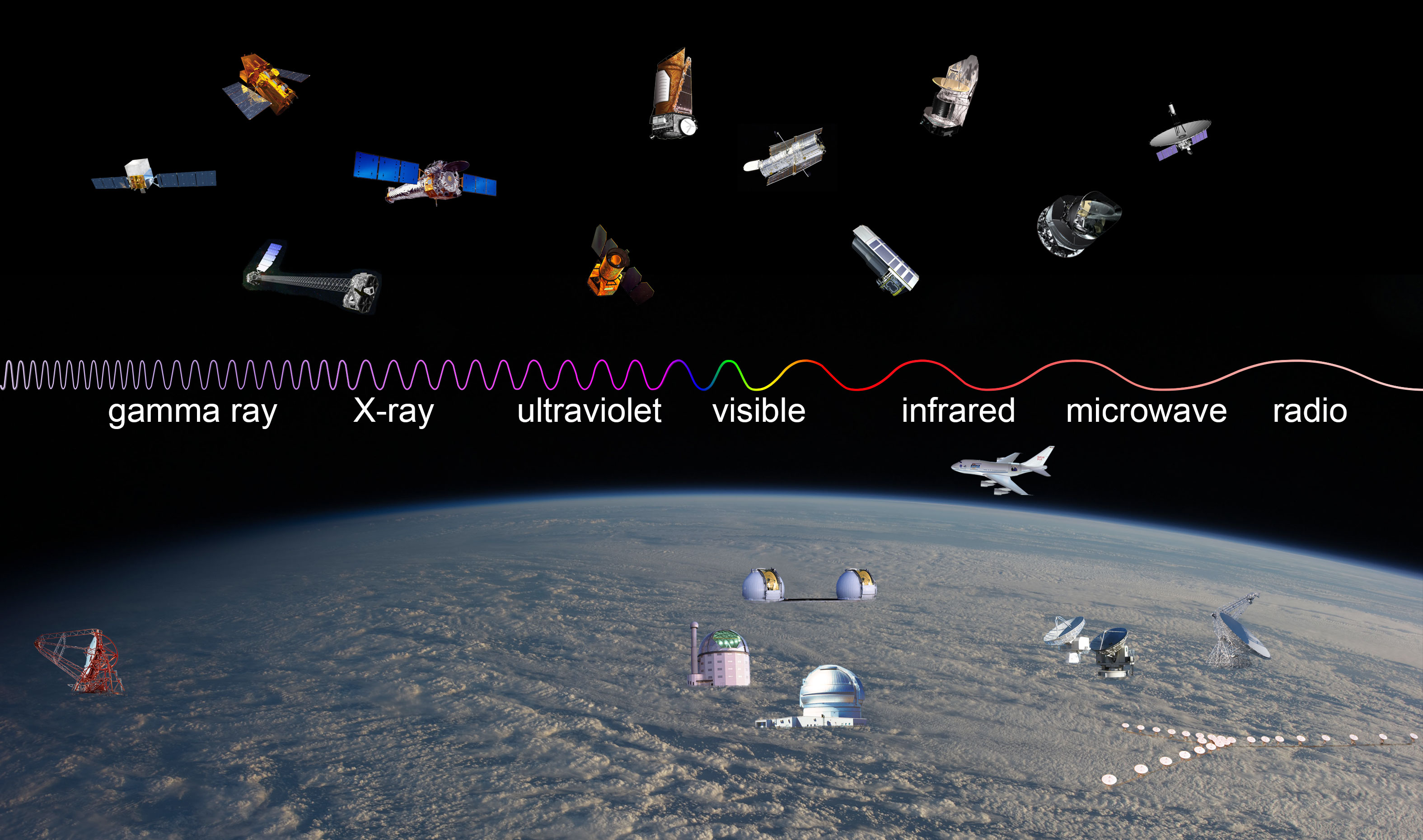
X-ray telescopes are well suited to study these regions for two
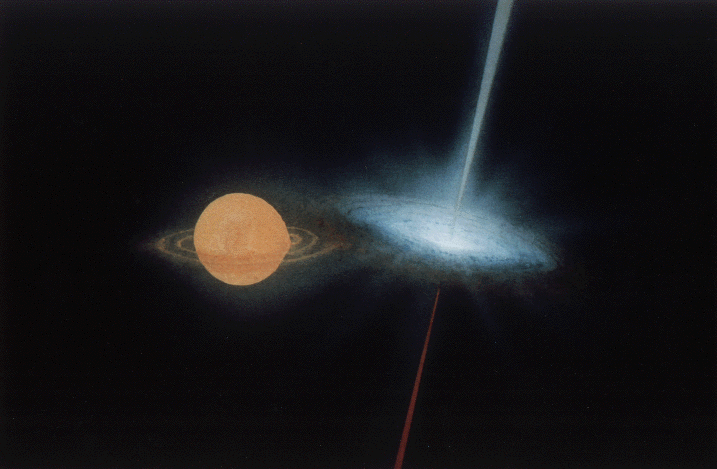
fundamental reasons. First, the power unleashed by
matter
crashing onto a neutron star or falling into a black hole shines
predominantly in X-rays, particularly in the regions closest to these
objects, where gravity is at its strongest. Also, X-rays can penetrate
through the obscuring veil of
dust
and gas surrounding black holes and neutron stars, which blocks the
passage of other forms of
radiation.
The field of X-ray astronomy continues to verify key predictions of
general relativity with greater certainty as X-ray telescope technology
continues to improve. Some of these methods include: gravitational
redshifting,
which is gravity tugging at a
photon,
or light particle, as it tries to escape;
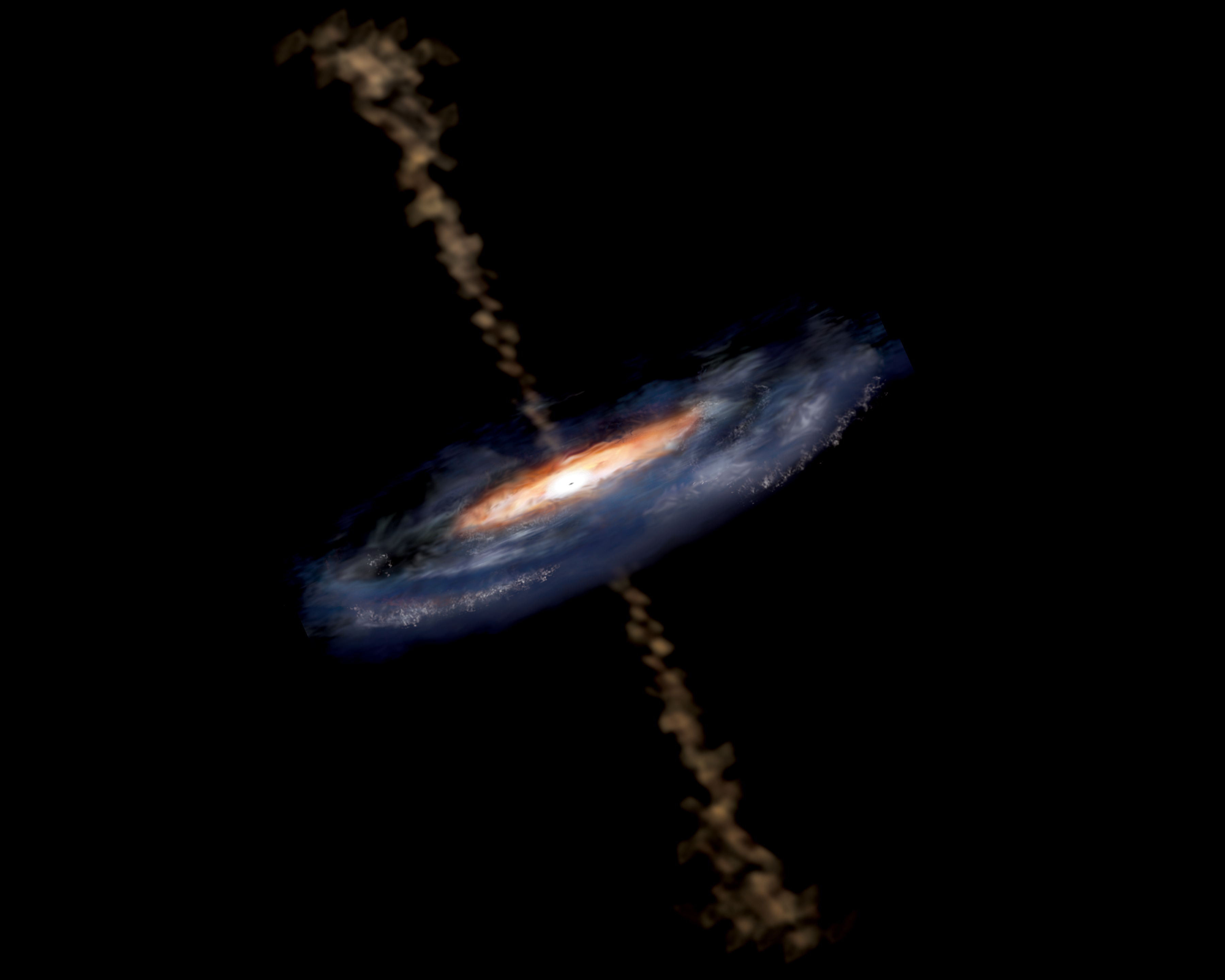
frame-dragging, which is a spinning object twisting the actual fabric of
space along with it; gravitational lensing, which is the path of light
bent by gravity; and Einsteinian
orbits
(an innermost stable orbit).
For example, in 1995, astronomers using the Japanese-built
ASCA
X-ray
satellite
observed the first clear indication of gravitationally redshifted light
around a black hole. ASCA detected a broad iron line, which is a
spectral feature in the emission of hot iron atoms around a black hole
revealing that strong gravity was stealing energy from the emitted
light. This verified Einstein's prediction that black holes create a
gravitational well, which a photon of light must climb out of on its
journey towards Earth. Today, the
Chandra X-ray
Observatory
and the XMM-Newton satellite observe this phenomenon with greater
precision.
Also, the Rossi Explorer has observed some of the more exotic
predictions of general relativity. First in 1998 and again with better
accuracy in 2001, scientists observed the frame-dragging
phenomenon. Einstein's equations predicted that a spinning object
with strong gravity would take spacetime, as well as any matter within
its gravitational influence, for a spin along with it. This effect would
make it hard for any object to fall onto the black hole directly,
because the object would be accelerated in orbit along the same spin as
the black hole, and would resist falling more than an object that was
not affected by frame-dragging.
General relativity has many consequences regarding what happens to
stars.
It determines that neutron stars, made in
supernovae
from stars that have consumed all their nuclear fuel, cannot be more
massive than about three
solar masses.
More massive collapsed remnants cannot be neutron stars (they become
black holes instead). So far, we have no contradiction.
General relativity also has consequences for the environments of
neutron stars and black holes. Material cannot orbit too closely. As
opposed to
Newtonian
law, which permits matter to orbit at any
radii,
general relativity predicts an innermost stable orbit. Again, so far
there is no contradiction. In fact, the Rossi Explorer has determined
that one certain black hole is spinning by virtue of an extremely tight,
stable orbit – an orbit predicted for a spinning black hole of a
given mass. Also, scientists observe quasi-periodic oscillations, or
X-ray flickering, that, so far, are best explained by the effects of
general relativity and the concept of an innermost stable orbit.
Yet as far as X-ray astronomy has come, scientists have been unable
to test general relativity completely. Such an undertaking could point
the way to a better theory of gravity, the same way that Einstein's
improved upon Newton's theory. The endeavor could also bridge general
relativity with quantum theory, an independent pillar of modern
physics.
General relativity describes the domain of the large-scale, the force
of gravity. Quantum theory, part of the Standard Model, describes the
small-scale, the subatomic. The quantum forces are
electromagnetic
radiation (light, photons), strong forces (the kind that holds together
protons and neutrons to form a nucleus), and weak forces (seen in
radioactive decay). Gravity, as of yet, does not fit into the Standard
Model; the so-called graviton, a particle of gravity, has not been
found.
Yet gravity does not act alone. General relativity defines this force
as the result of mass and energy (united in E=mc2). Mass
(matter, atoms) and radiation (photons) are controlled by quantum
theory. Thus, the connection between the two theories is indeed logical
and tantalizingly close at hand. Particle physicists refine quantum
theory with the help of particle accelerators, smashing
protons
and
electrons
to reveal the matter and energy within. Astronomers must develop tests
to better scrutinize gravity. Future X-ray observatories – some in
development, others proposed for launch at the close of the next decade
– will move us closer to a black hole, step by step.
One possible future mission, the Micro-Arcsecond X-ray Imaging
Mission (MAXIM), is a follow-up to the Rossi Explorer and would provide
more precise timing of the X-ray flickering characteristics of neutron
stars and black holes. This would reveal fainter features in the
quasi-periodic oscillations, which may be a signature of general
relativity. MAXIM's mission would include imaging a black hole
event horizon.
With an image of the event horizon and accretion disk as a point of
reference, scientists would be able to determine exactly from where
X-rays of varying energies arise. Knowing precise distances from the
black hole to X-rays of specific energies would allow for accurate tests
of Einstein's math.
Updated: June 2011
|