|
|
BLACK HOLES
American physicist John Archibald Wheeler first coined the term "black
hole" in 1967. Before the adoption of the term by Wheeler, the objects
now known as black holes were referred to as frozen stars, dark stars, or
collapsed stars. Black holes come in all sizes. Stellar black holes are
the result of massive stars dying. Supermassive black holes are believed
to have been created during the early Universe. The exact mechanism by
which they were created is under debate. Some scientists believe in the
existence of mini-black holes that were created at the same time as the
Universe. This type of black hole, they maintain, is the approximate
size of an atom yet has the mass of a large mountain. No matter what the
size of a black hole, they all share a common characteristic; not even
light can escape their gravitational pull. Though black holes have
probably been around since the Universe began, only recently have we
begun to learn in-depth information about them. In the last few decades
astronomers began to look at the Universe in the radio, infrared,
ultraviolet, X-ray, and gamma-ray regions of the electromagnetic spectrum
and have been able to gather much more black hole data.
STELLAR BLACK HOLES
Astronomers suspect that most black holes are produced when massive stars
(at least 8-10 times the Sun's mass) reach the end of their lifecycle.
Inside a star, gravity tries to pull matter closer together. While a
star is glowing, it is consuming its fuel through a nuclear process known
as fusion. It radiates not only light, but heat as well. The pressure
of the heated gases pushing outward balances the force of gravity pulling
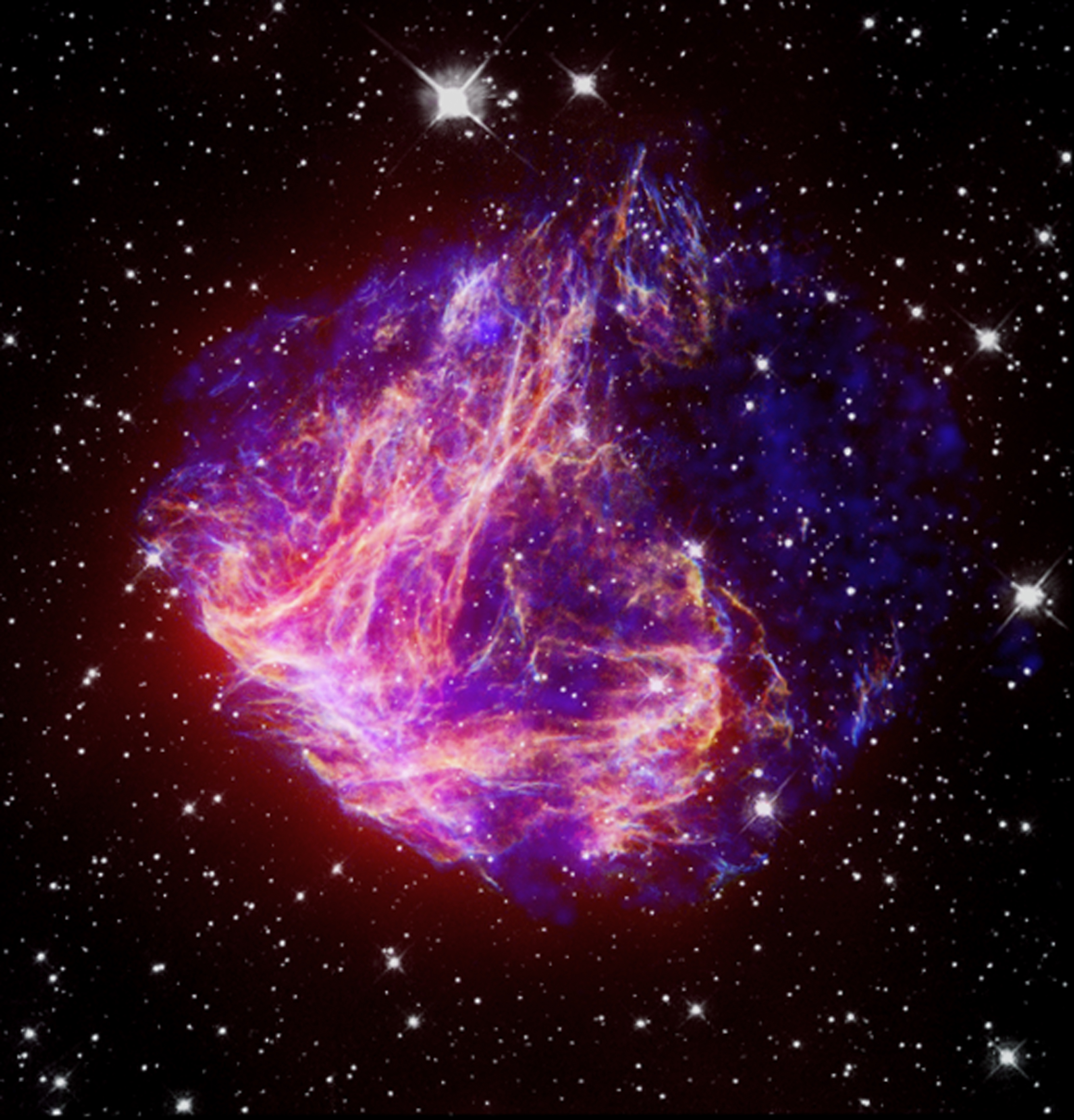
inward. Once the star's nuclear fuel has been depleted, the star becomes
unstable and the core implodes causing the outer shell to explode in a
supernova. If the remnant core that remains after the supernova is less
than 3 solar masses, gravity compresses the electrons and protons so that
neutrons form. The pressure of neutrons in contact with each other
counteracts the forces of gravity. This stable core, which is now
composed almost entirely of neutrons, forms a neutron star. Neutron
stars possess tremendous mass and consequently have a very powerful
gravitational pull. If the remnant left after the supernova is greater
than 3 times the Sun's mass, not even the neutron pressure can counteract
gravity and the remaining material will continue to contract. The
remnant collapses to the point of essentially zero volume (yet it has
infinite density!). This creates a mathematical singularity. A
singularity resides in the center of all black holes.
A spherical region known as the event horizon marks what scientists call
the "boundary" of a black hole. It is given this name because
information about events which occur inside this region can never reach
us. The distance from the singularity to the event horizon is known as
the Schwarzschild radius, after the German physicist who predicted the
existence of a "magic sphere" around a very dense object. Inside the
region, he theorized, gravity would be so powerful that nothing could
escape from it, i.e., the gravitational pull would be so strong that the
velocity necessary to escape the pull is unobtainable. A black hole has
such an enormous concentration of mass in such a small volume that in
order to escape from it, an object would have to be moving at a speed
greater than the speed of light. At this time we know of nothing that
can attain the necessary velocity.
Download a pdf version.
|