|
|
Remember that a stellar black hole was once a star. Most stars have a
companion star to which they are bound in a binary system. This nearby
companion can be a source of material on which the black hole "feeds".
Matter can be pulled off the companion in large swirling streams of hot
gas that spiral toward the black hole as a fast moving incandescent
whirlpool known as an accretion disk. As the matter in the disk falls
closer to the black hole, it heats up and gives off radiation such as
X-rays. By measuring the motion and radiation from an accretion disk,
astronomers are able to infer the presence and mass of the black hole.
When all of the material in the accretion disk has been consumed, the
disk disappears and the black hole is virtually undetectable. Stars and
planets at a safe distance from the black hole's event horizon will not
be pulled in toward the black hole. They will instead orbit the black
hole just as the planets orbit the Sun in our solar system. The
gravitational force on stars and planets orbiting a black hole is the
same as when the black hole was a normal star.
SUPERMASSIVE BLACK HOLES
Supermassive black holes have masses comparable to those of a typical
galaxy. These masses range anywhere from 10 billion to 100 billion of
our Suns. Supermassive black holes tend to be in the centers of
galaxies, creating what are called Active Galactic Nuclei (AGNs). An AGN
emits more energy than would be expected from a typical galactic
nucleus. The answer as to why this is so lies in the presence of the
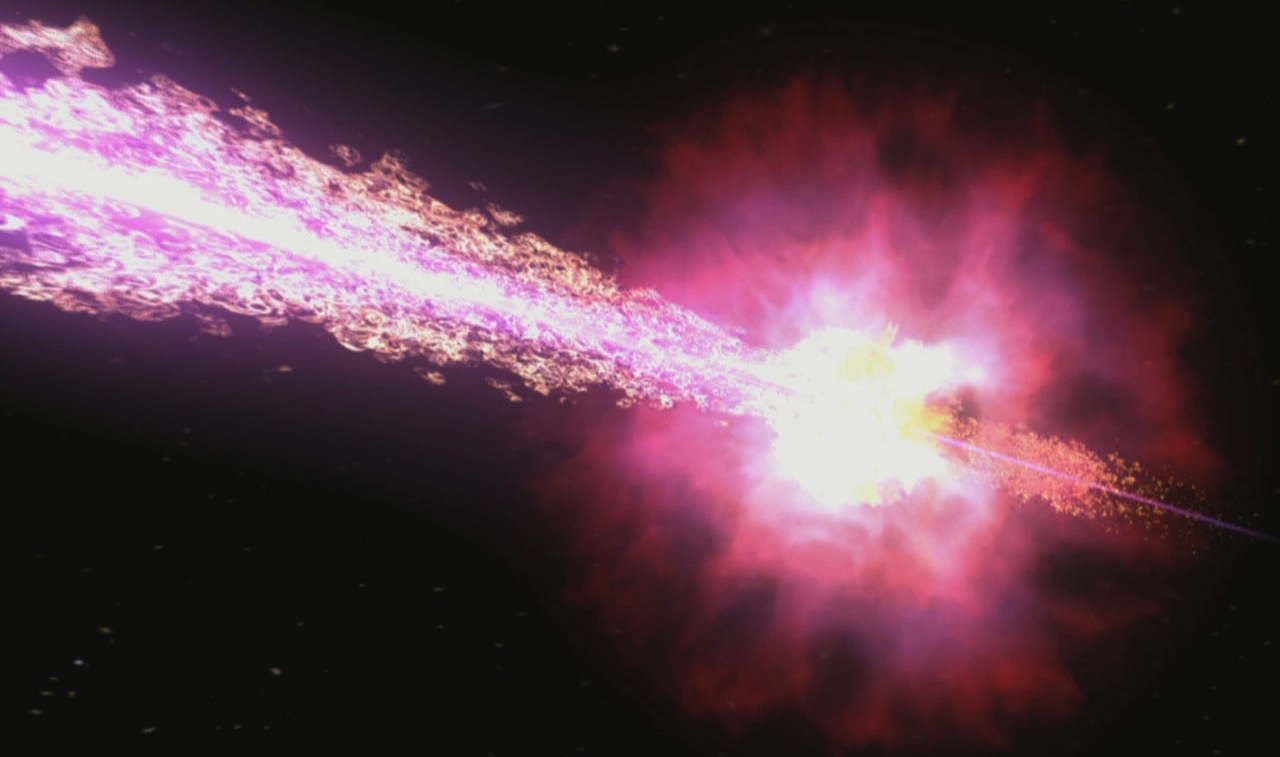
supermassive black hole in the galactic center. In some AGN, the massive
black hole and its accretion disk somehow produce outward-moving streams
of particles that are projected away perpendicular to the disk. These
streams are known as jets and have the power to accelerate electrons
almost to the speed of light. This produces gamma-rays that can be
detected by gamma-ray observatories. The most powerful AGNs in our
Universe are called quasars. We have been able to detect quasars that
reside 15 billion light-years away. Scientists believe that the study of
quasars will provide information about the Universe during the time of
early galaxy formation.
Download a pdf version.
|