|
IV. Activities
1. Apparently, They Are Absolutely Bright
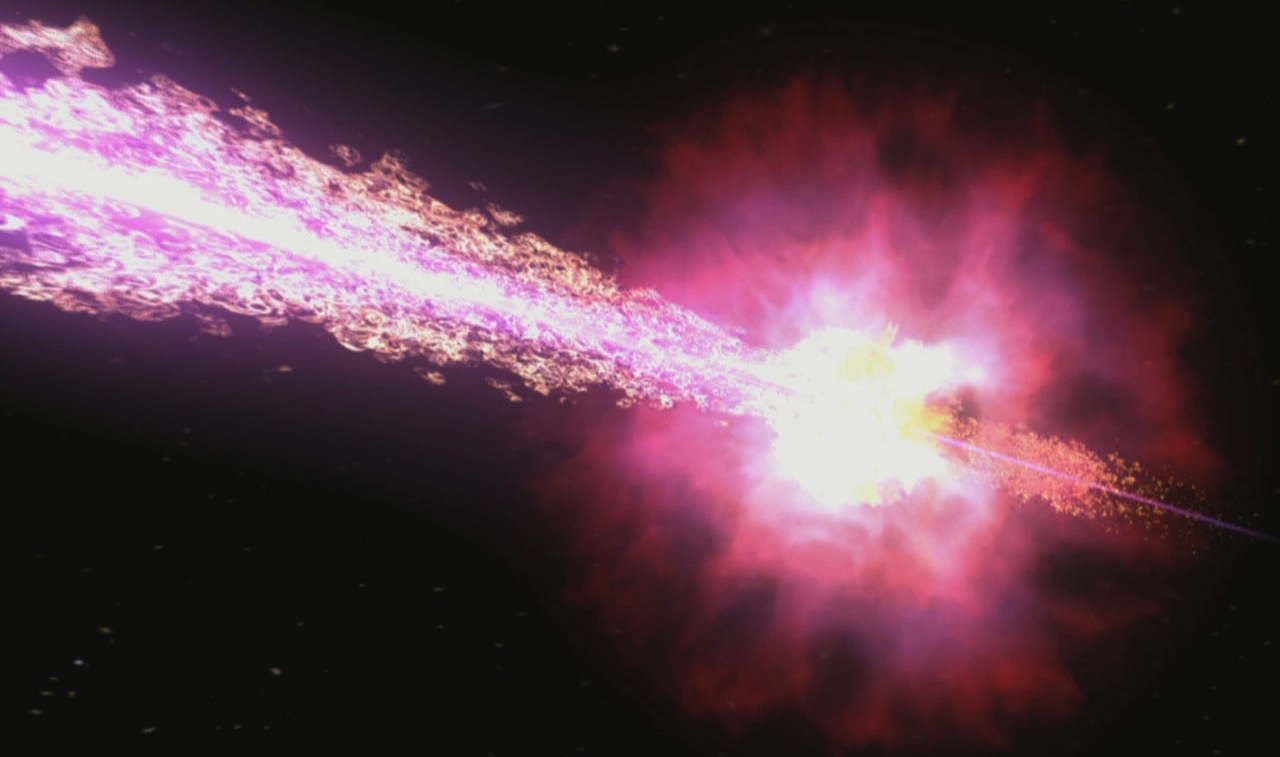
At a press conference discussing the event GRB 990123, Dr. Chryssa
Kouveliotou of Universities Space Research Association at the Marshall
Space Flight Center said "If the burst had occurred somewhere in our
galactic neighborhood, it would have been so bright that night
would've turned into day." What exactly does this tell us about how
bright it was?
Astronomers express the brightness of stars in visible light in two
related forms. Apparent visible magnitude, mv, measures the light that
reaches us on Earth. This measure, however, is not a true measure of
brightness because distance makes things appear dimmer and apparent
magnitude does not correct for this effect. Absolute magnitude, Mv, is
a true measure of how much light an object is actually
producing. Determining how bright the star (or galaxy or any other
emitter) would be if it were located 32.6 light-years (10 parsecs)
away compensates for the effect of distance. Note that here we assume
space is completely transparent in all directions, so only distance
affects what we detect. If clouds of dust intervene between the
emitter and us (as they usually do), we have to compensate for that
effect too!
Electromagnetic radiation (regardless of whether it is in the form
of radio waves, infrared, or gamma-rays) has a common property called
the inverse square law. This law states that the amount of energy that
is measured by a given detector put at a given distance from an
emitter is proportional to the inverse square of the distance from the
emitter to the detector. Think about it this way. An emitter E is
sitting a distance R away from a detector D. The emitter is radiating
equally in all directions. Place an imaginary sphere of radius R
around the emitter. The emitter releases a certain amount of energy in
1 second. This energy travels outward in all directions such that in a
time T, it reaches the surface of the imaginary sphere a distance R
away. This means that now, the original energy, let us call this
amount O, is spread out equally over the surface of a sphere of radius
R. The surface area of a sphere of radius R is equal to 4 pi R2.
Thus, the amount of
energy passing through each square centimeter of the sphere is
O/4piR2, if R is
measured in centimeters. We see, then, that the amount of energy
passing through a unit area decreases with the square of the distance
from the source. This is the inverse square law of light
propagation.
It is important to realize that we now have something to consider
when we analyze our observations of the Universe: an object may appear
bright because it really is, or it may be bright because it is close
by. Conversely, an object may appear dim because it really is, or else
it could be just very far away. Such thinking played an important role
in the history of understanding GRBs. When they were first detected
and their enormous energies calculated, it was believed that they had
to be located in our Galaxy. The amount of energy they would be
required to produce if they were very far away was just too difficult
to seriously consider. Now, however, we know that in fact they are at
cosmological distances - that is, very far away indeed. Scientists are
still working hard to understand how the enormous energy required for
us to be able to detect them from so far away (with the energy falling
off as 1/R2) is created. Beaming, which means the energy is not
emitted equally in all directions, but instead in a narrowly defined,
preferred direction is the most probable answer.
It is easy to demonstrate the fall off of light in your classroom
with a graphing calculator, Calculator-Based Laboratory
(CBL), and
light probe. In the exercise, you will measure the intensity (or
brightness) of a light as it is moved away from the light probe of the
CBL. The resulting data can be graphed and analyzed. For detailed
discussions of an activity of this type, see
Real-World Math with the CBL System, Activity 7, Light at a Distance
Exploring Physics and Math with the CBL System, Activity 43, Intensity of Light
Physical Science with CBL, Experiment 25, How Bright is the Light?

In short, place a 40W (or less) bulb in a shadeless lamp or
socket. Put a meter stick at a known distance about 2 meters away from
the bulb and on the same level. Place the light probe next to the end
of the meter stick closest to the bulb. Make sure nothing obstructs
the path between the two. Darken the room. Run the appropriate program
on the TI-83 (either BULB, LIGHT, or PHYSCI) and follow the directions
it gives you. Make a measurement, then move the probe such that the
distance to the bulb increases about 10 cm. Repeat until you have 10
measurements. Plot the intensity values you measured as a function of
distance.
What form do your data take? Linear? Power Law? Quadratic?
______________________________________________________
Now fit your data using your graphing calculator. What happens to the shape of the line if the fitting parameters become larger? Smaller?
______________________________________________________
Perform the experiment again with either a brighter or dimmer bulb. Consider also taking data at different distances. You should now be able to discuss the following:
When an astronomer measures the brightness of an object in the Universe, what sort of conclusions can be made about the energy being emitted by that object? What additional information would help the astronomer?
______________________________________________________
______________________________________________________
______________________________________________________
______________________________________________________
______________________________________________________
______________________________________________________
Extensions:
Investigate the magnitude scale in depth -- learn about Norman R. Pogson; learn about the mathematical equation that relates the magnitude values and fluxes of different objects; learn about where our Sun ranks on the magnitude scale.
Investigate what astronomers call the distance modulus and use it to determine how bright a star would be on the magnitude scale as you move it closer or further away from Earth. What effects would intervening dust have on this calculation?
Download a pdf version.
|