2. It's Either Probable, or It's Not
Imagine looking up at the night sky with an ordinary
telescope. What do you see? Constellations of stars, possibly a
satellite orbiting Earth, and maybe a planet or two. But now think
about looking with a magical telescope that would allow you to see
gamma-rays-- the most energetic form of radiation. Among many exotic
phenomena, chances are you would see an event called a Gamma-Ray Burst
or GRB!
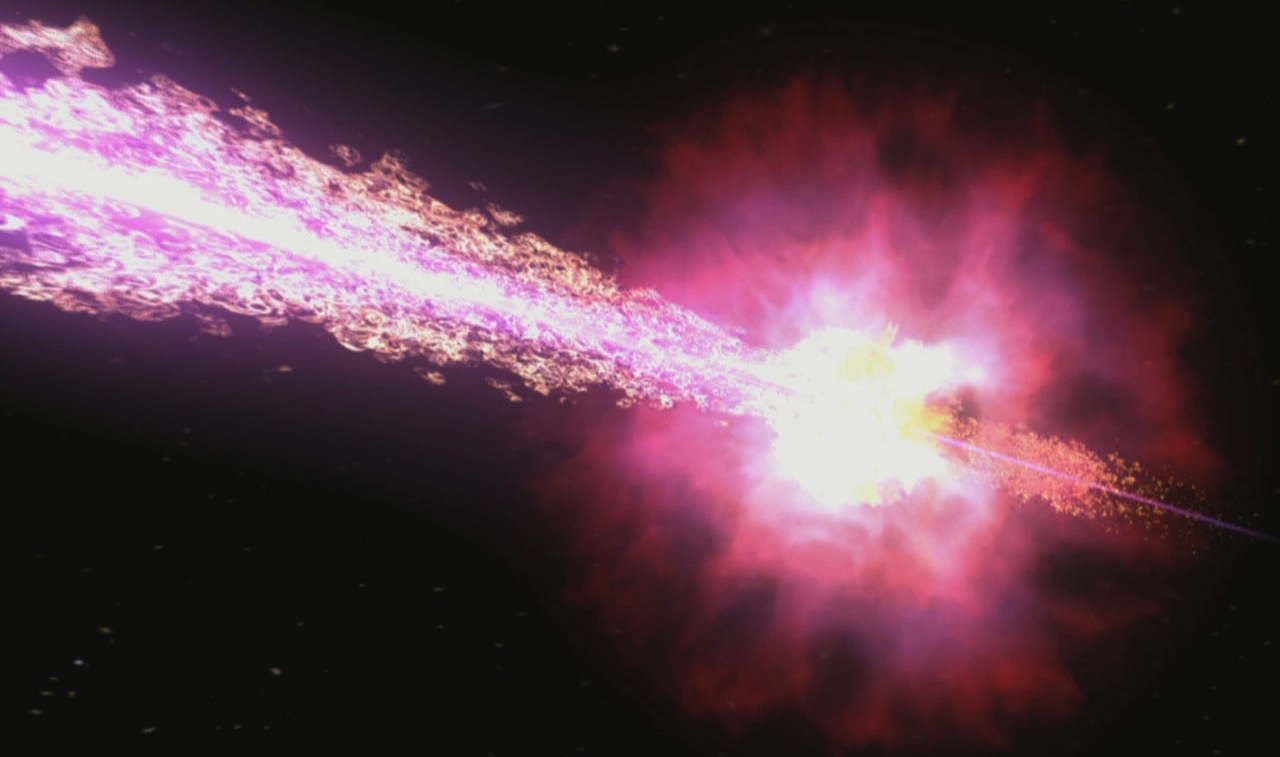
A Gamma-Ray Burst is a phenomenon that comes from the hottest,
fastest, densest, or most powerful objects in the Universe! A burst
will last anywhere from 0.01 to 1000 seconds, during which time it
will be the brightest source in the gamma-ray sky. Sometimes a burst
is brighter than all the rest of the gamma-ray sky added together!
GRBs occur a few times a day at a random time and from a
random direction in the sky (see below).

1. Examine the image above. It shows the location in the celestial
sphere of 2000 GRBs as seen by the BATSE experiment onboard a NASA
gamma-ray astronomy satellite. Do you see a pattern to the
distribution of locations of
GRBs?_____________________________________
Move into your groups of two, and discuss this with your partner.
2. Approximate a projection of the celestial sphere by a circle.
Draw this circle with radius of 4 inches and on a blank sheet of paper.
3. Imagine now that you are designing a "magical"
telescope or
Gamma-Ray detector. Assume your detector will see 1/5 of the circle at
any time (Realistically, all detectors have limitations!).
You may select any part of the circle that would represent 1/5 of the
area of the circle. Color this area in with a red pencil.
4. What would be the theoretical probability that your detector
would observe a given Gamma-Ray Burst? _________________
5. Now remove everything from your desk except your drawn circle.
One person should be the "circle holder", the other should
be the "burst marker". With marker in hand (felt tip exposed
pointing down), and eyes closed, the "burst maker" should
begin randomly dropping the marker until the circle has 50 marks in it
(some marks may be outside of the circle). The "circle
holder" should keep the circle centered on the desk and ensure
that the "burst marker" is moving his/her arm randomly
up-down-left-right before dropping the marker.
7. Now examine your marked circle.
What is the experimental probability
that a GRB occurred in your detector's area? _________________
8. Explain what you think would happen after 100 trials.
______________________________________________________
______________________________________________________
______________________________________________________
What about 1000, or 10,000?
______________________________________________________
______________________________________________________
______________________________________________________
9. Imagine you are the Principal Investigator for the next
generation
Gamma-Ray astronomy satellite. Use what youve learned in this investigation to design your satellite
Think about these questions...
10. Do you need to look at the whole sky all the time or can you look at a
smaller part of the sky for a longer interval and achieve the same result?
What are the advantages and disadvantages of each approach?
Now explain your mission to Dr. Gam A. Ray. Note that spelling and
grammar count along with a well thought out and explained mission.
The origin of the GRB is one of the most fascinating mysteries of
modern astrophysics. The amount of energy released in a burst can be
greater than the rest-mass energy of the Sun, and momentarily creates
the most extreme conditions in the Universe since the Big Bang. GRBs
can generate up to 1053 ergs/second! In the past few years,
astronomers have begun to make small inroads to the origin of GRBs. It
may be the result of the merger of two compact objects like neutron
stars or black holes, or of a more exotic event called a
hypernova. None of these theories have been observationally
confirmed. In fact, current instruments cannot tell us the answer. It
will depend on the next generation of detectors and telescopes to
solve the mystery of gamma-ray burst.
Download a pdf version.
|