3. Blast from the Past
Dr. Shri Kulkarni of the California Institute of Technology and his
colleagues found that a certain gamma-ray burst came from a faint
galaxy with a redshift of 3.4. "That means that the burst
originated over 12 billion light-years away," Dr. Kulkarni said. How
did he know that?
Redshift is a term astronomers often use for the Doppler Shift
observed in the spectra of celestial objects. Two things can create
the shift - the motion of the object toward or away from the observer,
or motion near a strong gravitational field. The Doppler effect is
named for Christian Doppler (1803-1853), who pointed out that if a
light source is approaching or receding from an observer, the light
waves will be (respectively) crowded together or spread out. Consider
this: if the light source is stationary with respect to the observer,
it will emit wave crests of light at regular intervals 1,2,3,4, and
spread out in all directions evenly. However, if the source is moving
toward the observer, successive wave crests are emitted from
different, shorter distances from the observer. To the observer, this
has the effect of making the waves appear shortened...and shorter
wavelengths appear toward the blue end of the spectrum. The opposite
effect occurs if the emitter is moving away from the observer, the
distance between crests appears to be lengthened - or shifted toward
the red end of the spectrum.
If the motion is entirely either directly toward or away from the observer, the equation which relates the velocity of the motion to the apparent shift in wavelength is:
Dl/l = (sqrt(1+v/c) / sqrt(1-v/c)) 1 Dl is the difference between l the emitted wavelength and
the wavelength measured by the observer, c is the speed of light, and
v is the relative line of sight velocity of the observer and source
(it is counted as positive if the velocity is away from the observer
and negative if the velocity is toward the observer). If the relative
velocity is small compared to the speed of light, this equation
reduces to the more common and simpler form
Dl/l = v/c
In astronomy, the Doppler shift is a very powerful tool from which
can lead us to know not only how fast something is moving, but also
how far away from us it is. Between 1912 and 1925, Astronomer
V.M. Slipher at the Lowell Observatory first measured the radial
velocities of galaxies using the Doppler shift. He discovered that
they all seemed to be moving away from us...the Universe was
expanding! By 1929, Edwin Hubble at the Mt. Wilson Observatory
determined the distances to galaxies for which velocities had been
measured and found that these two parameters were proportional to each
other. This relation is now known as the Hubble law. It can be written
as v = Hr, where r is the distance, H is the constant of
proportionality called the Hubble constant, and v is the velocity. The
Hubble constant is currently believed to be between 60 and 75 km/s per
million parsecs.
What do the redshifts (which astronomers define as Dl/l) have to do with GRBs? Try this:
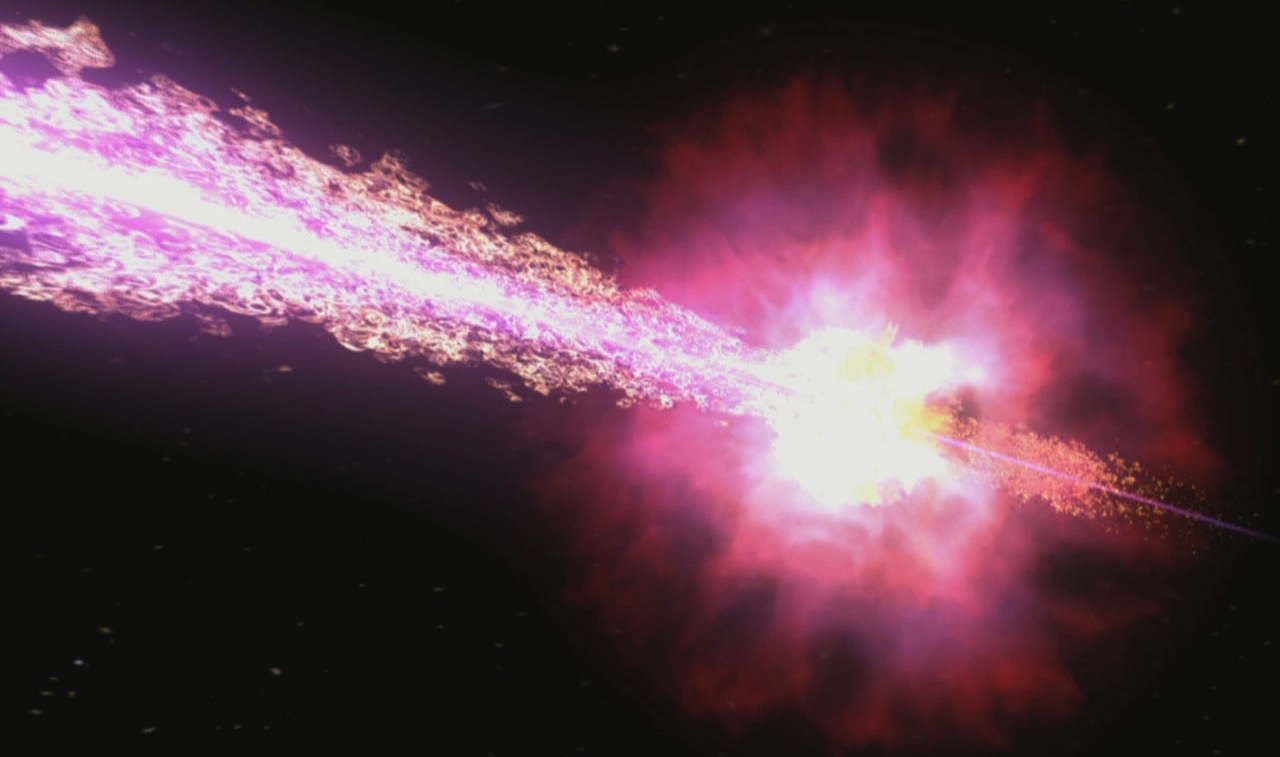
In a few cases, shortly after the detection of a GRB, high-powered
ground- and space-based observatories were able to detect the
afterglow of the event. These observations provided scientists with
the data to determine the host galaxy of the event and obtain a
redshift measurement of that galaxy. Redshift measurements allowed a
determination of the distance to the source of the GRB!
Examine the table below. Use what you have learned about
redshift to determine the velocities and distances of the galaxies
which appear to host the GRB events. Perform these calculations with
both the minimum and maximum Hubble constant values. HINT: The
material associated with GRBs is moving very, very fast so the
simplified version of the Doppler shift equation cannot be used.
| Burst | Redshift |
| 970508  | 0.835 |
| 971214  | 3.418 |
| 980703  | 0.966 |
| 990123  | 1.6 |
______________________________________________________
______________________________________________________
______________________________________________________
______________________________________________________
Given your knowledge of how fast gamma-rays travel, how long has it taken them to reach us from such a distance?
______________________________________________________
______________________________________________________
______________________________________________________
______________________________________________________
What does this tell us about the age of the Universe?
______________________________________________________
______________________________________________________
______________________________________________________
What must have happened in the Universe already in order for a GRB to occur?
______________________________________________________
______________________________________________________
______________________________________________________
Download a pdf version.
|