|
|
Gamma-Ray Bursts
I. Introduction
Perhaps the greatest mystery for astronomers who look at the sky at
very short wavelengths has been the incredibly brief and intense
bursts of gamma-rays from seemingly random locations in the sky. A few
times a day, the sky lights up with a spectacular flash, or burst, of
gamma-rays. Often, this burst outshines all of the other sources of
cosmic gamma-rays added together. The source of the burst then
disappears completely. No one can predict when the next burst will
occur or from what direction in the sky it will come. For thirty
years, astronomers have been trying to understand the nature and
origin of these gamma-ray bursts (GRBs).
Gamma-ray bursts were first discovered by Ray Klebesadel at Los Alamos
National Laboratory. He was working on a project responsible for
monitoring the Soviet compliance with the Nuclear Test Ban Treaty. A
series of satellites called Vela were put into orbit to perform
this task. After the first 4 satellites were up, Klebesadel and his
colleagues started to look through the data they sent back to
Earth. Primarily, they were looking to make sure everything was
working as expected and that nature was not generating any sort of
signal that could trick the satellites into thinking a nuclear
explosion has occurred. This was a painstaking task of looking through
stacks of computer printouts by hand. In fact, instead of graphs that
would quickly show what happened, Klebesabel's people had to examine
columns of numbers and look for significant changes in their
values. In mid-1969, Klebesadel was examining data taken on July 2,
1967. He noticed a spike in the data, a dip, a second spike, and a
long, gradual tail off. "One thing that was immediately apparent was
that this was not a response to a clandestine nuclear test,"
Klebesabel said at a conference held about GRBs in Huntsville, AL in
1998. His team checked for possible solar flares and supernovae, and
found none.
After this first event was noticed, other similar events were
quickly discovered in the data printouts. With the timing between
Vela 5 and 6 synchronized to within 1/64th of a second,
the Vela team was able to triangulate the locations of the
bursts by comparing differences in arrival times at widely separated
satellites. They confirmed their suspicion that the bursts came from
outside the solar system. Already, by their random scatter across the
sky, the data hinted that the sources were out in the Universe rather
than being confined in our Galaxy. By 1973, when Klebesadel and his
team were ready to publish the results in Nature and present
them at the American Astronomical Society meeting, there were at least
16 confirmed bursts.
Using a hard X-ray detector on board the IMP-6 satellite
(which was intended to study solar flares), Tom Cline and Upendra
Desai of NASA/GSFC were the first to confirm Klebesadels
findings and provide some spectral information which showed that the
burst spectra peaked at gamma-ray energies. Thus the events were not
simply the high-energy tail of an X-ray phenomenon. A collimated
gamma-ray telescope on board OSO-7 was also able to confirm a
direction to one of the events, supporting the original conclusion of
cosmic origin. These confirming results, published close on the heels
of the original discovery, gave the whole scenario an aura of enhanced
mystery. The excitement created in the astronomical community was
evidenced by a burst of publications of instrumental and theoretical
papers on the newly discovered "cosmic gamma-ray bursts".
Over the next 20 or so years, a catalog of GRBs was constructed and
many theories were discussed as to their origin. Great debates were
even held within the astronomical community as to whether the bursts
were occurring in our Galaxy or in other galaxies. The addition of
each newly observed burst tended to reveal not much more than that
they never repeated from the same source. The launch of the Compton
Gamma-Ray Observatory in 1991 ushered in a new era of GRB
observations. The Burst and Transient Source Experiment (BATSE) was
capable of monitoring the sky with unprecedented sensitivity. As time
passed and the catalog of bursts observed by BATSE grew, one thing
became clear: the bursts were in no way correlated with sources in our
Galaxy. It began to be accepted that GRBs must originate in galaxies
far, far away. In 1997, the Italian-Dutch BeppoSAX satellite
made a breakthrough in our understanding of GRBs. Using a particularly
effective combination of gamma-ray and X-ray telescopes,
BeppoSAX was able to detect afterglows from a few GRBs and
precisely locate the sources so that other telescopes could study the
same locations in the sky. This work showed that GRBs are indeed
produced in very distant galaxies, requiring the explosions producing
them to be extremely powerful.
The next big breakthrough in understanding GRBs occurred when an
enormously powerful event was detected on January 23, 1999 (designated
GRB990123). It was observed with an unprecedented range of wavelengths
and timing sensitivities. A small automated optical telescope
responded to alerts from orbiting gamma-ray and X-ray telescopes to
begin observing the GRB within 22 seconds of the bursts
onset...while the GRB was still on-going. Subsequent observations took
place over the next few weeks in the gamma-ray, UV, optical, IR,
millimeter, and radio. The object was determined to have a redshift of
1.6, putting it at a cosmological distance and implying a staggering
energy release. In fact, if the energy were emitted equally in all
directions, twice the rest mass energy of a neutron star would be
required. If the energy is being beamed out in a preferred direction
that happens in this case to point directly toward Earth, however, the
required energies are more reasonable and easier to
explain. Multiwavelength, prompt observations of many bursts will be
required in order to determine the central engine (or engines...there
may be more than one mechanism!) of GRBs.
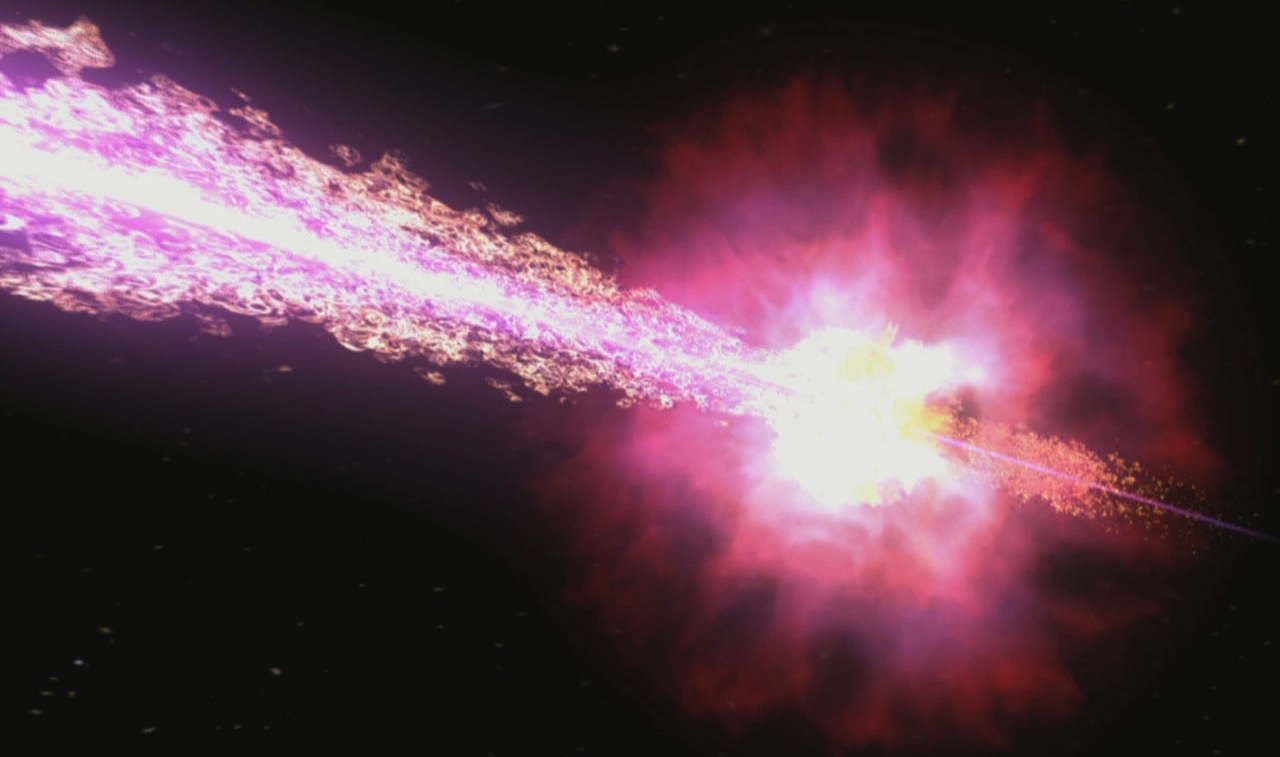
We tentatively believe GRBs are produced by material shooting
towards us at nearly the speed of light, which was ejected during the
collision of two neutron stars or black holes. Alternatively, the
events could arise from a hypernova, the huge explosion hypothesized
to occur when a supermassive star ends its life and collapses into a
black hole. However, our sample size is small and our knowledge base
shallow.
Download a pdf version.
|