|
|
II. GRBs - What we know and what we don't know
1. We know what they look like in time in gamma-ray wavelengths
Perhaps the most striking feature of the time profiles of gamma-ray
bursts is the diversity of their time structures. Some burst light
curves are spiky with large fluctuations on all time scales, while
others show rather simple structures with few peaks. However, some
bursts are seen with both characteristics present within the same
event! However, no persistent, strictly periodic behavior has been
seen from gamma-ray bursts. A common quote amongst gamma-ray
astronomers is "If you've seen one gamma-ray burst,
you've seen one gamma-ray burst!"
The durations of gamma-ray bursts range from about 30 milliseconds
to over 1000 seconds, although the duration of a gamma-ray burst is
difficult to quantify since it is dependent upon the sensitivity and
the time resolution of the experiment which observes the event. The
"tip of the iceberg" effect tends to cause weaker bursts to be
observed as shorter, since only the higher parts of the peak emission
are observable.
2. We are beginning to know what they look like in other wavelengths
Gamma-ray bursts were named when they were discovered in the early
1970s; at that time, they seemed to only emit radiation in the gamma
portion of the spectrum. Scientists thought it was odd that the bursts
appeared to only give off one form of energy. Most other energy
sources give off several forms of energy simultaneously. A flame, for
instance, gives off infrared (heat) and visible light. As it turns
out, gamma-ray bursts are more than just explosions emitting
gamma-rays. Now we know that it was our ability to see, rather than
the source, which was limited. Individual telescopes were only
designed to see one part of the electromagnetic spectrum. When a
gamma-ray telescope detects a burst, there was usually not enough time
to direct other telescopes to look at the explosion. All of this is
now changing. For GRB 990123, the ground-based Robotic and Optical
Transient Search Experiment (ROTSE) coordinated with the space-based
Compton Gamma-ray Observatory within 20 seconds of the start of
the explosion - just quick enough to catch a burst in action in
multiple wavelengths.

Three images from the Keck I telescope of the field of GRB 990123
(24 January 1999 UT, 29 January 1999, and 9 February 1999 UT). The
image is rotated to the standard orientation, so that the east is to
the left and north is up. By looking at the inset image blowups, it is
clear that in the 24 Jan image, the optical transient (OT) believed to
be associated with the GRB dominates the host galaxy flux, but by 29
Jan the galaxy is resolved from the OT. Three images from the Keck
I telescope of the field of GRB 990123 (24 January 1999 UT, 29 January
1999, and 9 February 1999 UT). The image is rotated to the standard
orientation, so that the east is to the left and north is up. By
looking at the inset image blowups, it is clear that in the 24 Jan
image, the optical transient (OT) believed to be associated with the
GRB dominates the host galaxy flux, but by 29 Jan the galaxy is
resolved from the OT.
Although the explosion only lasts for a few seconds, the afterglow
of a GRB can linger for weeks or even months. The afterglow follows a
path down the electromagnetic spectrum, first mostly emitting
gamma-rays, then peaking at X-rays, and so on, all the way down to
radio waves. Eventually, the afterglow fades completely from our
view. Because the afterglow is much longer-lived than the initial
explosion, various types of telescopes have been used to study the
afterglow. Most of our recent insight about gamma-ray bursts comes
from studies of the afterglow, although interpretations of the data
are still widely debated.
Every aspect of a burst, from the kind of radiation emitted to the intensity of the explosion, tells its own tale. By figuring out how all these different "points-of-view" fit into the main event, scientists hope to determine what really happens. With GRB 990123, scientists saw for the first time visible light emitted during a gamma-ray burst explosion. Although the burst was 9 billion light years away, the light was so bright observers on Earth could've seen it with a pair of binoculars. Scientists see the emission of this intense visible light as a clue that helps determine the structure of the explosion. Because material is flowing out from the explosion at different velocities, collisions occur. Such collisions in a gamma-ray burst create shock waves that generate various energy wavelengths.
In fact, scientists believe that three kinds of shock waves are
associated with gamma-ray bursts: external, internal, and reverse. As
the source of a gamma-ray burst explodes, material blows outward,
creating an external shock wave traveling away from the source of the
explosion. The impact of this fast-moving material pushing against the
interstellar medium creates reverse shock waves. Meanwhile, matter
still racing outward from the explosion at different speeds generates
internal shock waves. These internal shock waves push the reverse
shock waves outward. The reverse shock waves still appear to be
traveling inward, however, because they are slower and colder than the
internal shock waves.
 
3. We know that they come from every direction in the sky...
and from very far away!
The random occurrence of GRBs has been one of the
biggest problems with studying them -- we never know where the next
burst will come from! In the beginning, scientists thought that the
sources of GRBs would all be in our Milky Way Galaxy. This would then
cause the distribution of GRB locations to be concentrated along the
galactic plane (a line running between (+180 and 180 in the
image above). Today, primarily through the data from the BATSE
experiment, we know that bursts come from all over the sky with equal
probability. And the whole sky is a very big place to try to watch all
at once!
Although a long debate had been held concerning whether gamma-ray
bursts came from our own Solar System, the Milky Way Galaxy, or much
further away, the years 1997 through 1999 provided observations with
uncontroversial evidence that GRBs come from the distant reaches of
the cosmos. By watching the fading of the optical counterparts of that
bursts, astronomers were able to conclude that the explosions were
embedded in faint galaxies. For example, a day or so after GRB990123,
astronomers used the 10-meter Keck II telescope on Mauna Kea to
analyze ultraviolet and visible light from the fading afterglow. Their
data showed that the explosion took place about 9 billion light years
from Earth!
3. We Don't Know if the Radiation is Beamed
The amount of energy released from a gamma-ray burst boggles
the imagination. Exploding with the power of ten million billion suns,
only collisions between objects like super-dense neutron stars and
black holes have enough energy potential to create such a cataclysmic
event. But no one is sure what causes a gamma-ray burst; the mechanism
remains a mystery.
As powerful as all gamma-ray bursts are, GRB 990123 was at the top
1 percent of its class. GRB 990123 was so powerful that scientists
began to wonder if the light in the burst was beamed rather than
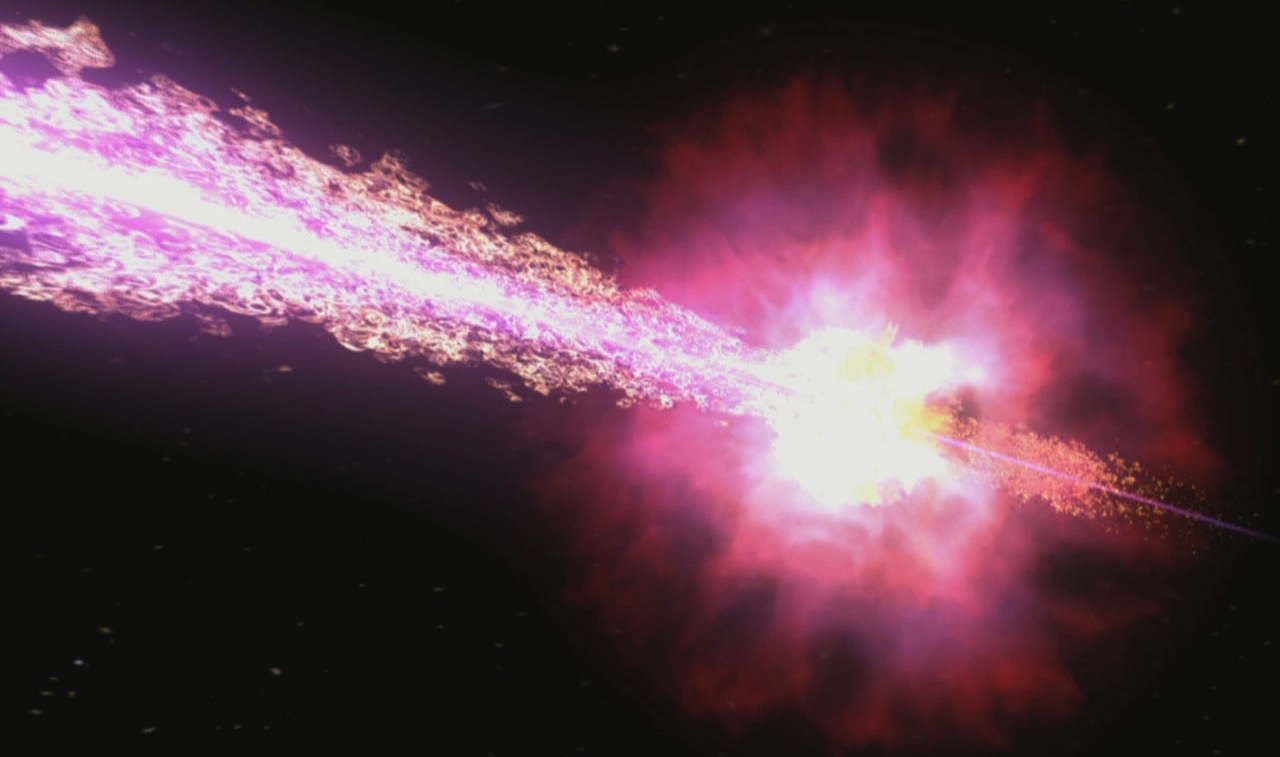
dispersed evenly, or isotropically. A beamed explosion is directed
like a flashlight, while an isotropic explosion is dispersed outward
like the emission from a light bulb. Beaming is actually quite common
in the emissions from astronomical objects. Data from the Hubble
Space Telescope showed a rapid decline in the optical brightness
associated with GRB 9990123. These data provide evidence for the
beaming theory, because beamed light appears to dim much more rapidly
than isotropic light. A beamed explosion would have all of its power
concentrated to a specific area. But an isotropic burst explodes
outwards to all points in space, so we would only see the part of the
energy directed toward us. Isotropic explosions, therefore, are more
powerful than they look. The calculation of a gamma-ray burst's total
energy depends on the dynamics of the explosion - an isotropic
explosion would be calculated to have much more power than a beamed
burst.
If gamma-ray bursts are beamed, the energies we're seeing are less
than we first thought, but that also means there are more of them out
there that we don't see. If the explosions are beamed in just one
direction,only
those observers located along the path of the beam would see
them. That means that there could be gamma-ray bursts exploding all
the time, but because the beams are focused in other directions we
don't see them. All is not lost, however! Regardless of whether or not
we see the beams of gamma-rays, we would still be able to see their
afterglows, because afterglows are always isotropic. If we find
afterglows without seeing the initial bursts, that would prove
gamma-ray burst explosions are beamed.
4. We Don't Know What Causes GRBs
For one brief moment, long ago in a far-away galaxy, a titanic
explosion poured a torrent of gamma-rays into space. Some 12 billion
years later -- Dec. 14, 1997 -- this flash of
radiation reached Earth. Headlines in newspapers and magazines, dubbed
this gamma-ray burst "the most powerful explosion since the Big Bang."
While that may be hyperbole (brighter bursts have been observed since)
researchers have calculated that this cosmic flash packed 100 times
more energy than a supernova explosion and calls into question the
popular theory in which GRBs are generated when two neutron stars
collide and merge, forming a black hole. Dale A. Frail of the National
Radio Astronomy Observatory in Socorro, N.M., noted that to generate
the energy associated with the Dec. 14 burst, a large fraction of the
rest masses of both neutron stars had to have been converted into
gamma-rays. Scientists find this unlikely.
Other damning evidence against this model was discovered in a later
GRB astronomers glimpsed an afterglow at radio wavelengths
before finding it in visible light. Such a sequence of events
suggests that the burst originated from a place containing a great
deal of dust, which blocks visible light but is transparent to radio
waves. Stellar nurseries (areas of new star formation) are rich in
dust, and previous studies have hinted that several other bursts
originated in star-forming locales. Neutron stars probably do not
merge within star-forming regions. During the 100 million years or so
that it takes for neutron stars to form and merge, they would migrate
far from their birthplaces.
Dr. Bohdan Paczynski of Princeton University and many other
astronomers now favor another model called a hypernova
explosion. Still considered a hypothetical notion, a hypernova may
emit 100 times more energy than a supernova. What causes a hypernova
remains unknown, although astronomers have proposed that they happen
when a very large and rapidly rotating star collapses directly into a
black hole.
It is likely that both the neutron star merger theory
and the hypernova theory are correct. Future observations will be
able to tell, as well as determining if the Universe generates GRBs
via other circumstances as well.
Download a pdf version.
|