Conclusions
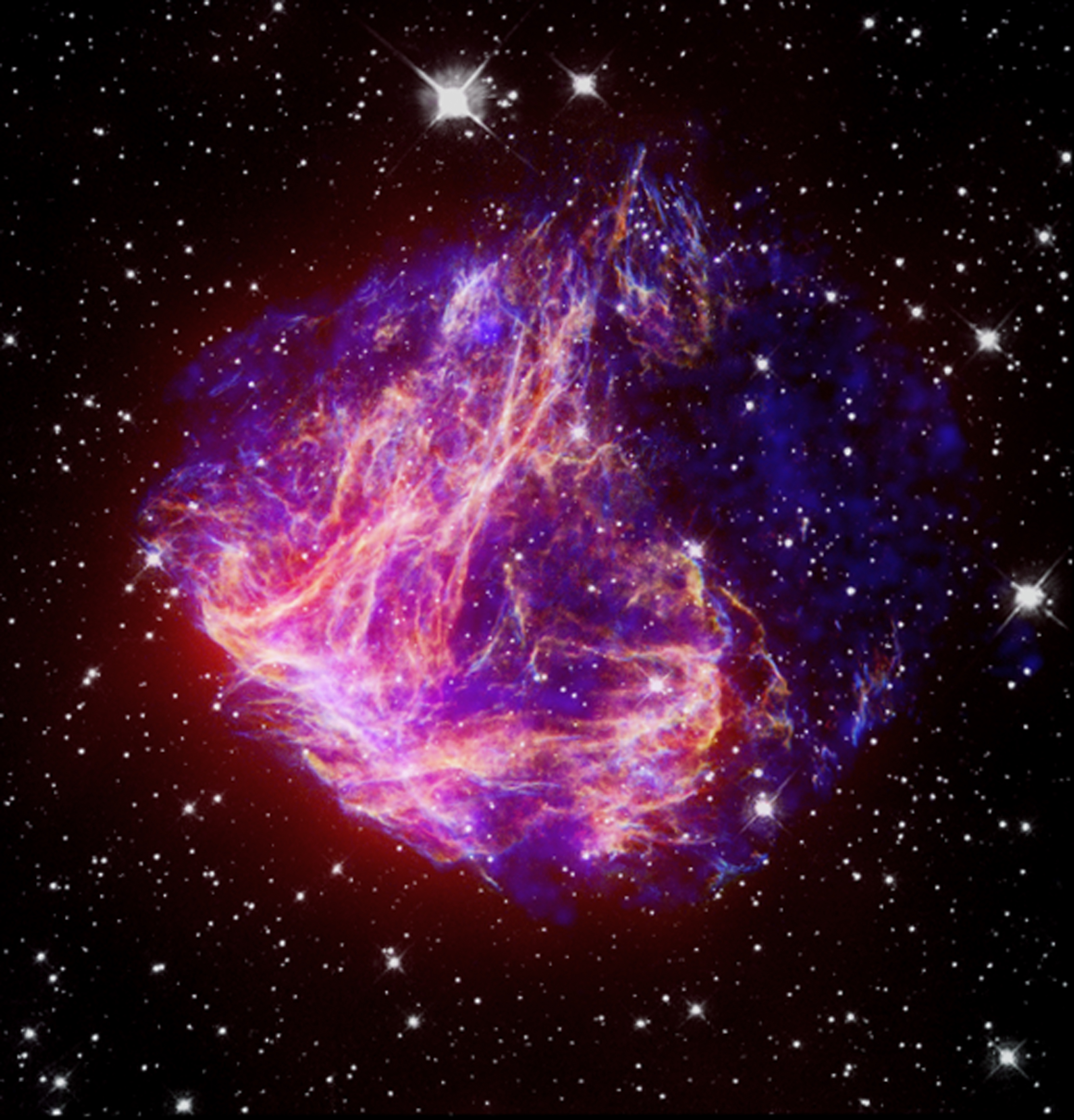
X-ray image of supernova remnant E0102-72 from the Chandra X-ray
Observatory.
Credit: NASA/CXO/SAO
The ions that you found all have only one or two electrons left.
These are called hydrogen-like and helium-like ions, since, like
hydrogen and helium, they have only one or two electrons orbiting the
nucleus.
These ions are very different from anything we would find on Earth.
They are likely generated by very hot gas, greater than 106
Kelvin, the temperature of the Sun's corona. This heat energy must come
from what is left over from the supernova. Estimates for the age of
this supernova remnant come from observations of its expansion rate, and
are in the range of 1000-2000 years. Thus, it takes a supernova a very
long time to cool off.
In this supernova remnant, we are seeing an incredible amount of
oxygen, neon, and magnesium (you should have found that your three
emission lines were O6+, Ne9+ and Ne8+;
you did not fit the magnesium line, but can clearly see it in the data
at about 1.35 keV). As discussed in the SNR Profile, these elements were made
inside a star. Now that the star has exploded, those elements are being
spread into interstellar space surrounding the supernova remnant in the
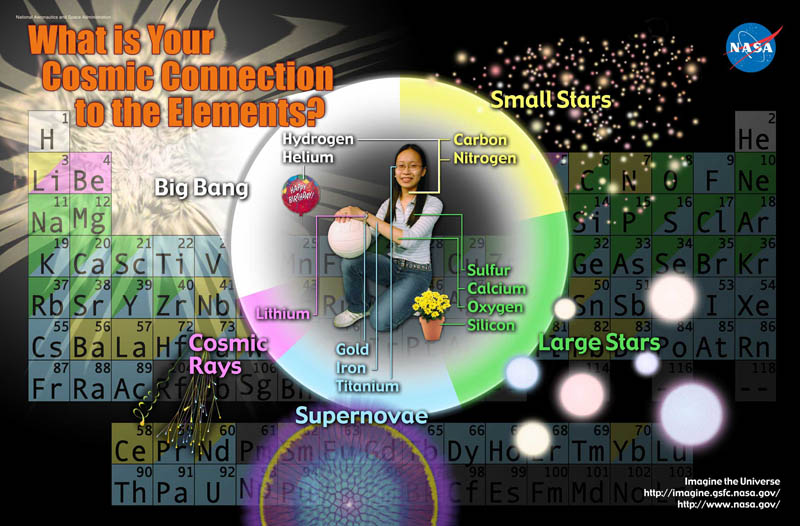
Small Magellanic Cloud. This is the process by which the elements we
are made of were originally produced.
|