|
|
The Dispersion of Elements
| In addition to making elements, supernovae scatter them. The
elements that are made both inside the star as well as the ones
created in the intense heat of the supernova explosion are spread out
in to the interstellar medium. These are the elements that make up
stars, planets and everything on Earth -- including ourselves. Except
for hydrogen and some helium created in the Big Bang, all of the stuff
we, and the Earth around us, are made of, was generated in stars, through sustained fusion or in supernova
explosions. |
Enrichment of the Space Between the Stars
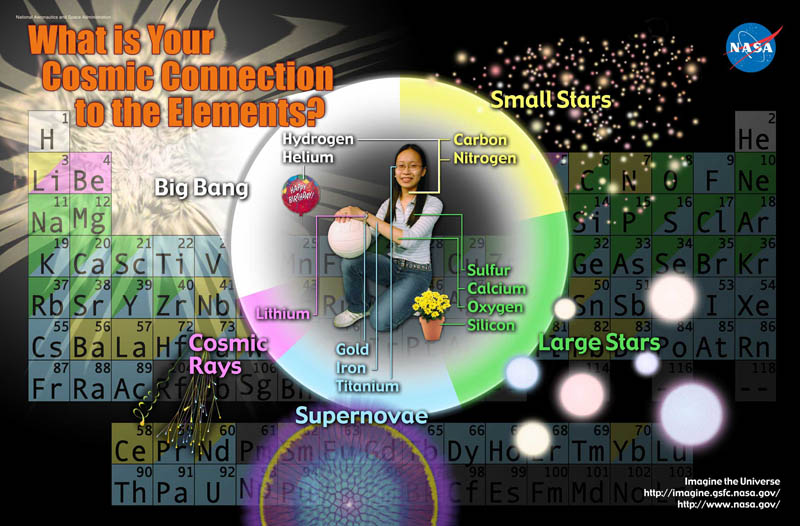
The most common elements, like carbon and nitrogen, are created in the
cores of most stars, fused from lighter elements like hydrogen and helium.
The heaviest elements, like iron, however, are only formed in the massive
stars which end their lives in supernova explosions. Still other elements
are born in the extreme conditions of the explosion itself.
Without supernovae, life would not be possible. Our blood has
iron in the hemoglobin which is vital to our ability to breath. We need
oxygen in our atmosphere to breathe. Nitrogen enriches our planet's soil.
Earth itself would be a very different place without the elements created
in stars and supernova explosions.
How do the elements that are released in the wake of a supernova explosion
end up in the make-up of a planet like Earth? Though we normally think of
space of being empty, it actually isn't. It might seem empty since the average
particle density of interstellar space is around 1 atom per cubic centimeter,
but there are some 1037 tons of this thin matter in
our Galaxy alone! We call the matter that fills the space between the stars
the "interstellar medium" or ISM.

The Periodic Table of the Elements
|
Supernovae change the chemical composition of the ISM,
by adding elements which were not present
before, or were only present in trace amounts. Though these explosions
only occur a few times a century in our Galaxy, they are responsible for the
synthesis of all the elements heavier than iron, including many we come across
in daily life, like copper, mercury, gold, iodine and lead. Most of the
elements which are produced in supernovae have small cosmic abundances and
very few have been directly detected in the interstellar medium.
The ISM is also enriched in other ways, by stars losing mass
due to the solar wind for example, but supernovae are the
main means in which it becomes enriched with heavier
elements.
|
The gradual enrichment of the interstellar medium with heavier
elements has made subtle changes to how stars burn: the fusion process
in our own Sun is moderated by the presence of carbon. The first
stars in the Universe had much less carbon and their lives were
somewhat different from modern stars. Stars that will be formed in the
future will have even more of these heavier elements and will have
somewhat different life cycles. Supernovae play a very important part
in this chemical evolution of the Universe.
Chaos and Structure

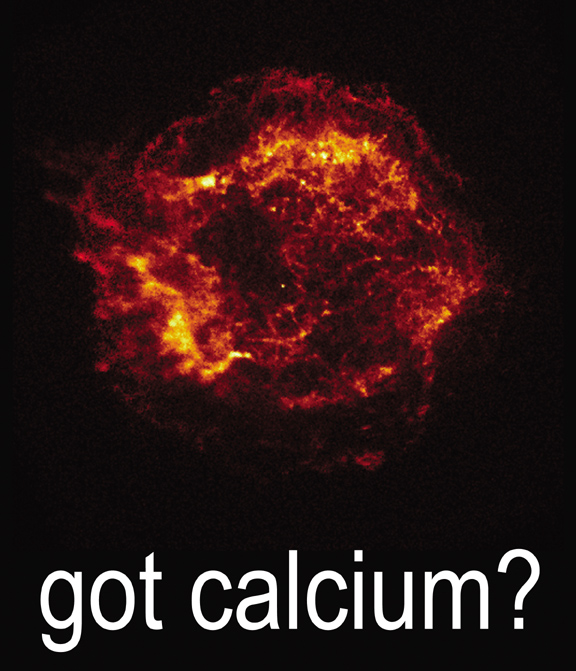
The Crab Nebula |
The chaos caused by supernovae, like the one that created the Crab Nebula (shown at left), is also responsible for the complex structure of the ISM. A
supernovae creates shock waves through the interstellar medium,
compressing the material there, heating it up to millions of degrees.
Astronomers
believe that these shock waves are vital to the process of star
formation, causing large clouds of gas to collapse and form new
stars. No supernovae, no new stars. |
|
What is the time scale? In tens of thousands of years after the initial
explosion, a supernova remnant may grow to 100 light years in diameter.
A few hundreds of thousands of years after the explosion, the ejecta
will eventually mix in with the general interstellar medium. The
supernova has thus enriched the interstellar medium with heavy elements
across a sphere a thousand light years across or so.
This means that millions or even billions of years
may elapse between the supernova explosion that creates an atom
of gold, for example, and the formation of the solar system where the
atom eventually ends up. That's a long time! In this amount of time, a
star can circle the Galaxy several times - and two stars that started off being
next to each other may have ended up on the opposite side of the Galaxy!
| 
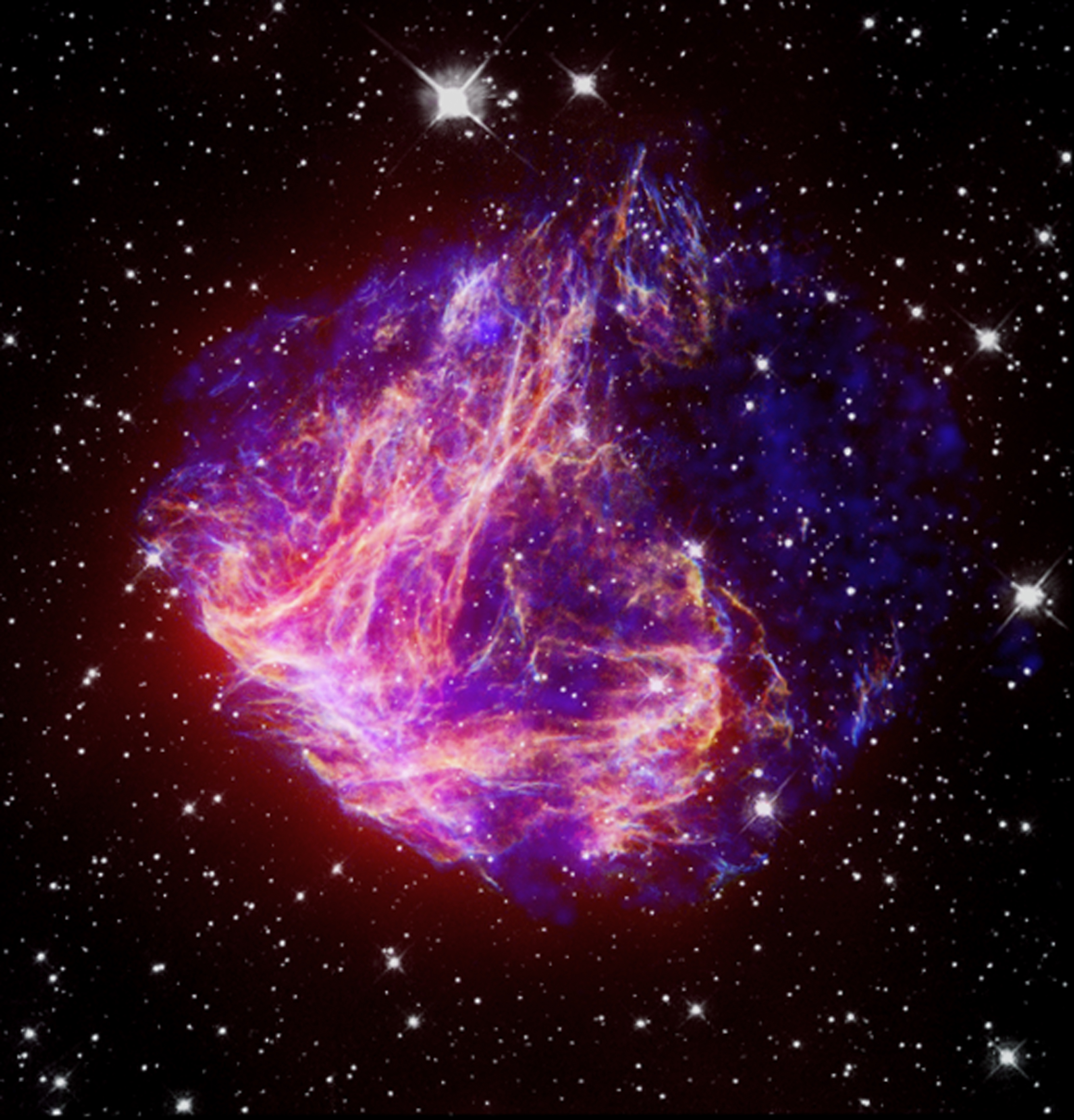
The Cygnus Loop
Credit: J. Hester (ASU), NASA |
It is impossible to speculate which
specific supernovae created the heavy elements that ended up in a
specific solar system;
the heavy elements that are in your body and in objects around you,
are the products of many different supernovae over many millions of
years all over the Galaxy.
Over many millions of years, the intersteller medium is continuously
enriched by thousands of supernovae. That makes it all the more amazing
when one tiny corner of the intersteller medium becomes dense enough,
and a solar system is formed.
For the Student
Using the text, and any external printed references,
define the following terms:
supernova remnant, interstellar medium, light year.
|
Reference URLs:
Supernovae
http://imagine.gsfc.nasa.gov/docs/science/know_l1/supernovae.html
http://imagine.gsfc.nasa.gov/docs/science/know_l2/supernovae.html
Life Cycles of Stars
http://imagine.gsfc.nasa.gov/docs/teachers/lifecycles/stars.htm
Element Production in the Universe
http://zebu.uoregon.edu/disted/ph123/l10.html
http://aether.lbl.gov/www/tour/elements/stellar/stellar_a.html
Back to the Main Spectra Unit Menu
|