|
1. What are the spectral classes of stars that have the following
maximum light wavelengths?
You will need to refer to the H-R Diagram!
(a) 3 x 10⁻⁵ cm (b) 1.5 x 10⁻⁵ cm (c)
5.5 x 10⁻⁵ cm (d) 1.25 x 10⁻⁴ cm
2. In what region of the electromagnetic spectrum would objects with
the following temperatures be best observed by a scientist's
experiment?
(a) .001 K (b) 800 K (c) 15,000 K (d) 1,750,000
K
Suggested Extension:
Are there really objects in space that have a temperature of 0.001 K?
What are you detecting at that temperature?
Bigger than a Breadbox?
The Universe is a very big place and it contains some very big
objects. In many images scientists create from data, it is difficult to
understand the actual sizes of the objects. In this activity, we want to
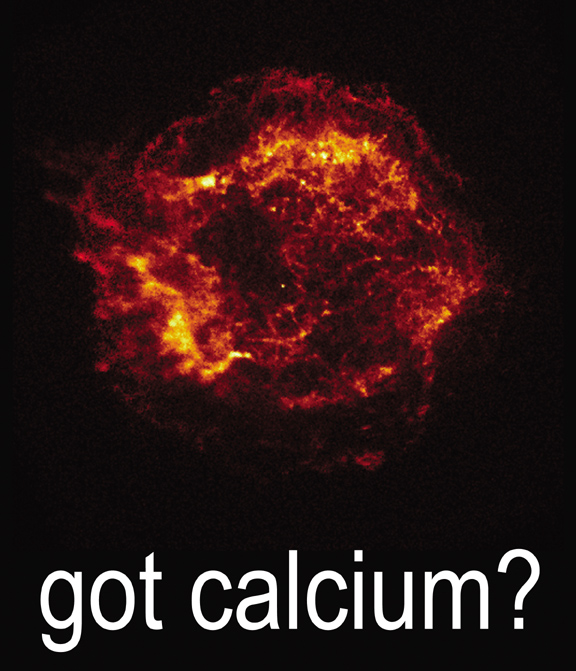
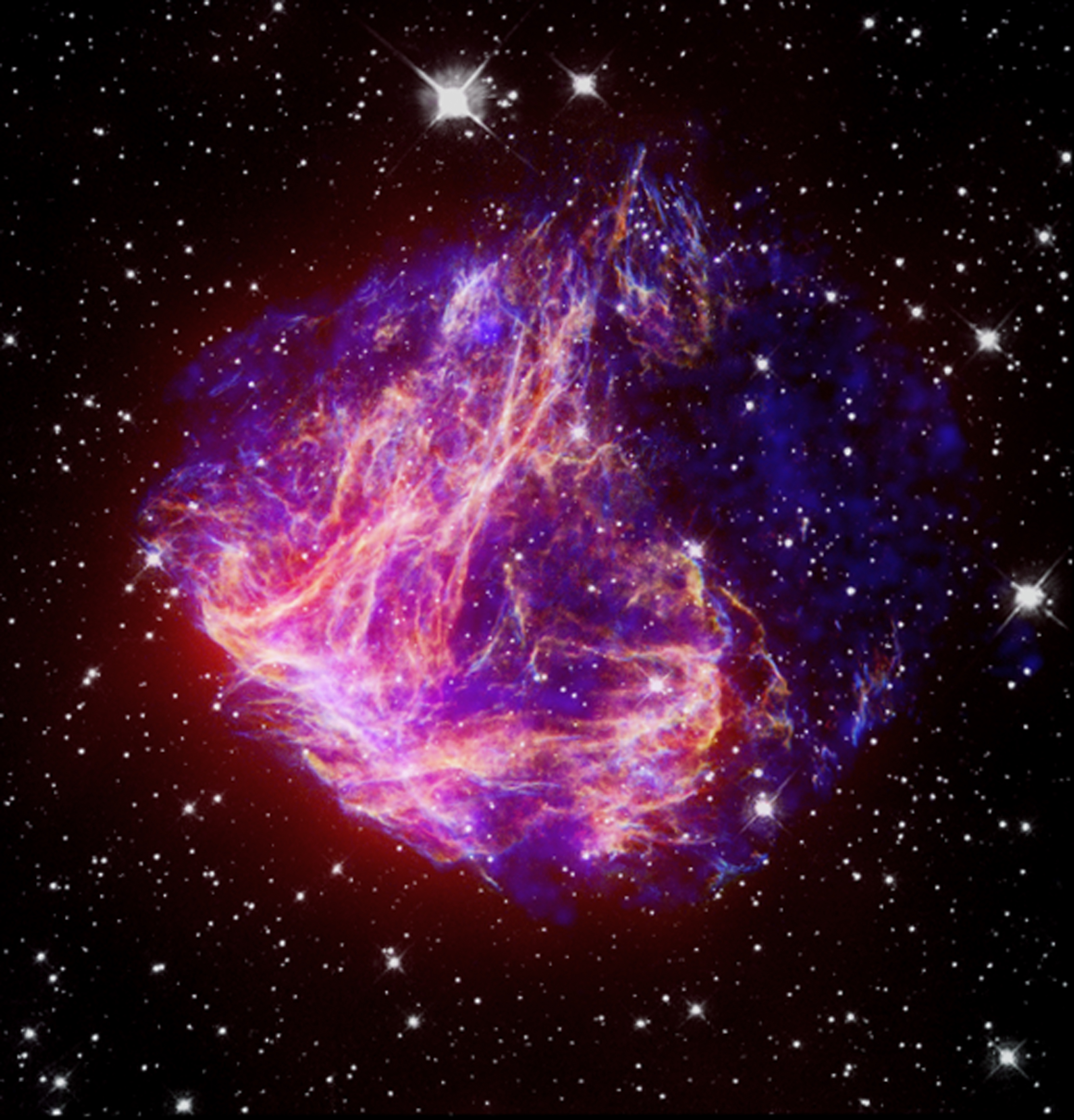
understand the extent (or size) of some supernova remnants. We will do
this by applying a simple physics equation.
In physics, we know that velocity = distance traveled / time it takes
to travel that distance.
or 
For this activity, we know that the distance (d) traveled is
equivalent to the distance from the initial or central star of the
supernova remnant, to the edge of the outer material of the remnant. In
addition, we know the velocity (v) at which the material of each
remnant is expanding outward, and understand that as the remnant gets
older the velocity slowly decreases. Lastly, we know how long ago
(t) the initial star blew up in a supernova explosion.
Use this information, and the following data to determine the biggest
supernova remnant among those listed below. Be careful with the
dimensional analysis!
Data:
Cygnus Expansion Velocity = 1,450 km/sec Age = 20,000
years
Crab Expansion Velocity = 1,500 km/sec Age = 943 years
Tycho Expansion Velocity = 5,200 km/sec Age = 425
years
SN1006 Expansion Velocity = 3,000 km/sec Age = 990
years
Download a pdf version.
|