|
|
Crossing the Event Horizon
If a black hole has no size, how do scientists talk about its
surface? Well, we don’t really mean the physical surface of the black hole
-- we mean the surface around the black hole at which the escape velocity
is equal to the speed of light. In other words, if you are closer to the
black hole than the distance to this surface, you cannot escape. If you
are further away from the black hole than this distance, then there is
still hope for you! The surface is called the event horizon, and its
radius is the Schwarzschild radius. (Named for Karl Schwarzschild, an
astronomer who was a member of the German army in World War I and died of
illness on the Russian front in 1916. He applied the equations of general
relativity to see what would happen to light near such a massive object.)
It is important to keep in mind that the event horizon is not a physical
boundary, but for all intents and purposes is the surface of the black
hole. Once inside it, you are cut off from the rest of the Universe
forever.
The relationship of the Schwarzschild radius to the black hole mass is
simple:

This can be easily understood by looking at the equation for the
escape velocity from any spherical body such as a planet or star,
namely, , where M and
R are the mass and radius of spherical object. For a black hole,
the escape velocity is equal to c, the speed of light.
- What would be the radius of a black hole with the mass of the planet
Jupiter?
- How would the period of the Earth's revolution change if the Sun
suddenly collapsed into a black hole? Note that this can never
happen!
- Suppose the Earth were collapsed to the size of a golf ball...becoming
a small black hole. What would be the revolution period of the Moon, at a
distance of 381,500 km? Of a spacecraft that had been hovering 300 m above
a point on the surface of the Earth before its collapse? Of a fly orbiting
at 0.5 cm?
About the Poster...
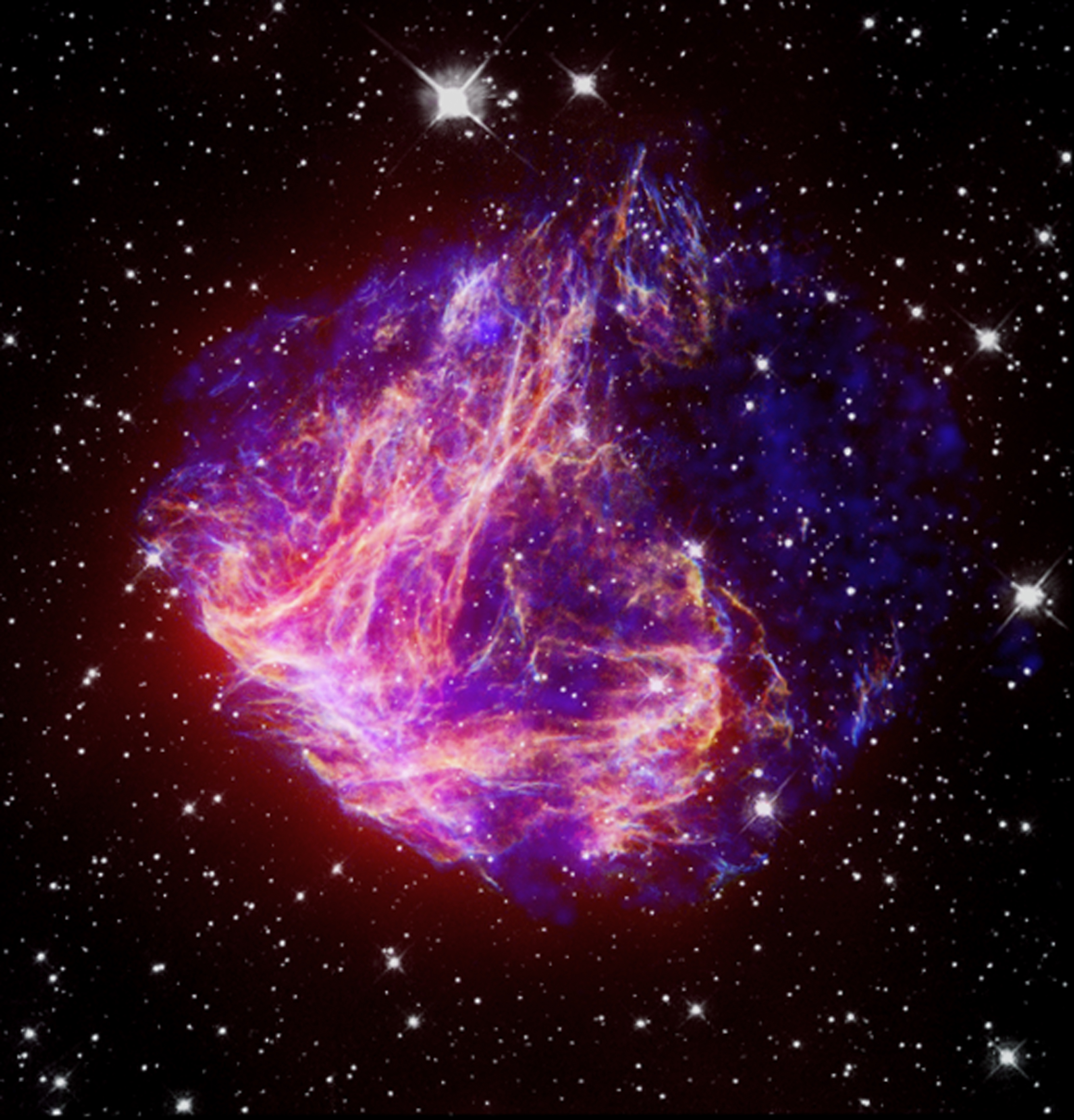
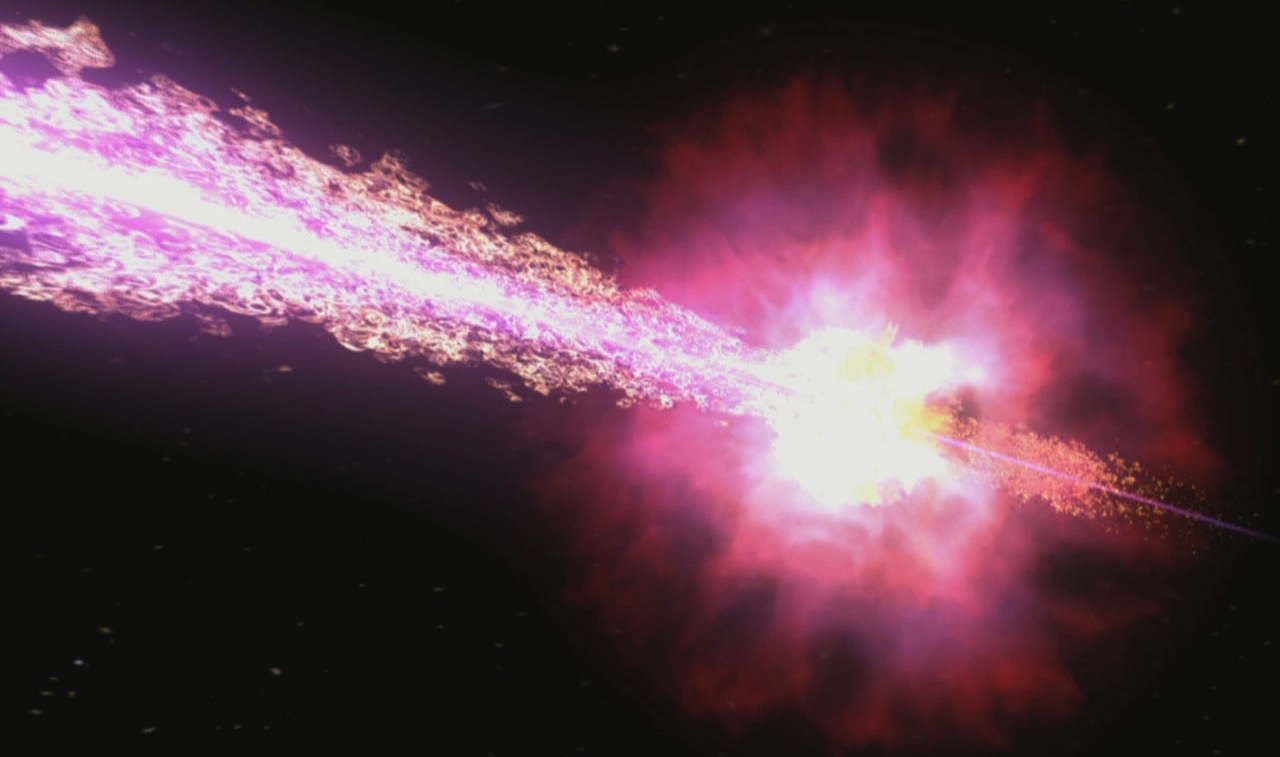
The images on the poster are a combination of actual images and
artist's alterations. The low mass star, low mass red giant, white dwarf,
black dwarf, neutron star, and black hole images are all artist's
renditions. The neutron star is depicted to emphasize its powerful
magnetic field. The black hole image shows the large accretion disk and
jets surrounding the black hole, which cannot be seen. Actual images are
described below.
Download a pdf version.
|