
How Far... How Powerful
How Far... How Powerful

An activity by Laura Whitlock, Kara Granger, and Padi Boyd
related to the AstroCappella song
'the Swift Song'
about Gamma Ray Bursts
- Summary
- Activity 1: The Fall-Off of Light
- Background: Hubble's Law and Redshift
- Activity 2: The Keck Spectrum
Activity Summary
Gamma Ray Bursts: Take your students on a journey to the edge of space and time!
To use these activities, follow the Activity Flow Chart. Specifically:
Step 1: Introduce the students to the big idea: what we know from stars and galaxies is all based on what we measure using detectors either on Earth or in orbit. How do we go from this information to an estimate of how far away the objects are, and how much power they are putting out? Let students brainstorm possible paths to these answers.
Step 2: Measure how light falls off with the Fall-off of Light Activity. Your class might break up into several groups, whose results could be averaged together. How close did your class come to the actual behavior of one over r-squared?
Step 3: Present the information found in Introduction to Hubble's Law and the Doppler Shift. The central, most important concept to get across is that Hubble discovered that the further a galaxy is from Earth, the greater its redshift - i.e. the faster it is receding from us. We can turn this idea around: if we measure the redshift of an object we can calculate its distance from Earth.
Step 4: Now, have your class perform the Keck Spectrum Activity. Students will use state-of-the art, timely astronomical data to measure the redshift of the gamma ray burst, and then use this information to estimate its distance from Earth. The final step of this activity applies the 1/r2 fall-off of light, the distance to the object, and the power measured at our detector, to estimate the total power emitted by the gamma ray burst.
Activity 1: The Fall-Off of Light
Objective
Your detector in orbit around Earth has measured a certain amount of energy from the direction of a faraway source. Your job is to determine how much energy the source actually emitted. Assume the source emits energy equally in all directions.Introduction
A light emits equally in all directions. What does this mean about the amount of light you will measure in any given square cm as you move further and further away from the light source?
Want to convince yourself that light really does fall off as 1/r2? Here is a quick, easy way!
Materials
- scissors
- tape measure
- tape
- single-hole hole punch
- dark orange or dark red paper (at least 7 cm x 7 cm)
- flashlight
- data table
- graphics calculator
Procedure
- Find a blank, flat wall to shine a light onto and a table or chair that can stabilize the flashlight for this lab. If you have a nice blank wall near the end of a lab table, you can just put the light on top of the table. You will need to be able to move the light (whether along the table or by moving the chair) at least 1 meter in distance closer to or away from the wall.
- Use the hole punch to punch a hole in the center of the dark orange or dark red paper.
- Tape the paper to the light end of the flashlight, making sure the hole is roughly centered over the light.
- Place the flashlight on the chair or table at least 10 cm from the wall. You can adjust it with papers or books so that it is level (i.e., the light beam shines perpendicular on the wall). Measure the distance from the wall to the hole on the front of the flashlight. Record this distance in your data table.
- Turn the flashlight on. You should see a distinct white circle projected on the wall. The rest of the light emitted outside of this light should be a shade of the colored paper taped to the flashlight.
- Take 3 different measurements of the diameter of the circle of white light on the wall. HINT: Remember, the diameter of a circle is the longest measured chord from one edge of the circle to the other. Therefore, you know you've got the diameter when you hold one end of the tape measure on one side (edge) of the circle and get the largest measured value by moving the other end of the tape measure along the other side.
- Record these values in the data chart. Calculate the mean and record it as well.
- Move the chair with the flashlight (or move along the table) about 20cm further away from the wall. Measure the distance from the wall to the hole on the front of the flashlight. Record this distance on your data table.
- Repeat steps 6-8 at least two more times.
- Calculate the radius from each mean diameter. Record each calculation in the data table.
- Calculate the area of the circle formed from each calculated radius. Record each calculation in the data table. HINT: Area of a circle equals
 r2.
r2. - In your graphics calculator, enter the distance from the hole to the wall as one list and the area of each calculated circle as another list.
- Plot the data in the lists as a scatter plot. What kind of relationship do you see?
- Calculate a Power Regression equation on the two lists. What is the equation?
Introduction to Hubble's Law and the Doppler Shift for Activity 2
During the 1920's and 30's, Edwin Hubble discovered that the Universe is expanding, with galaxies moving away from each other at a velocity given by an expression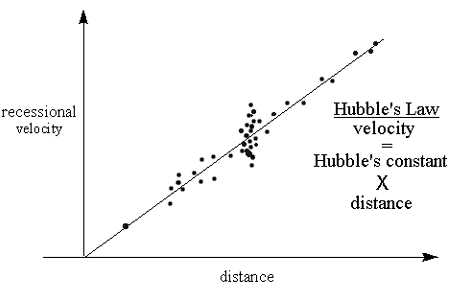

 = measured wavelength,
  is the original (rest) wavelength, v is the speed of the object and c is the speed of light. The quantity on the left side of the equation above is usually called the redshift, and is denoted by the letter "Z".
  and
and d = v/Ho = 3000/65 = 46 Mpc or 1.4 x 10⁸ light-years
Activity 2: A Keck Spectrum
Objective
Using optical data of a gamma ray burst afterglow, measure the velocity of the object from the redshifts of its spectral lines. Using Hubble's Law, determine the distance to this object. Ultimately, estimate the power of the gamma ray burst from its measured flux at Earth and its distance from us. (Flux is the amount of energy flowing through a given area in a given time - usually one second).An Unsolved Mystery of the Space Age
Gamma ray bursts have been known to exist since 1969, but they present many mysteries. They last for only a few moments, and they come from random directions on the sky. Since a satellite first discovered them in the early days of Space Science, gamma ray bursts are often referred to as the great mystery of the Space Age.Data Analysis
Keck is a pair of telescopes perched on the peak of Mauna Kea, Hawaii. They are the largest optical telescopes in the world, and their location high above much of the atmosphere provides the best observing conditions on Earth. On July 3, 1998 Keck II obtained the spectrum of the glowing remains of a gamma ray burst before it faded from our view forever. The spectrum shows the energy distribution of the light from the GRB.

A larger version of this plot is available.
|
||||||||||||||||||||
ResultsAverage Redshift R : _________ |
Discussion
The final step of this activity applies the 1/r2 fall-off of light, the distance to the object, and the power measured at our detector, to estimate the total power emitted by the gamma ray burst. Have students look up power emitted by more familiar events (an explosion, lighting a match, a 100 W light bulb are some examples). Explain that gamma ray bursts are very far away (we call these distances "cosmological distances") and they are the most powerful explosions in the universe.Reference
Additional Resources:For More Information on Gamma Ray Bursts:
The Gamma-Ray Universe. D. Kniffen in American Scientist, Vol. 81, No. 4, pages 342-350; July 1993.
The Compton Gamma Ray Observatory. Neil Gehrels, Carl E. Fichtel, Gerald J. Fishman, James D. Kurfess and Volker Schonfelder in SCIENTIFIC AMERICAN, Vol. 269, No. 6, pages 68-77; December 1993.
The Gamma-Ray Burst Mystery. D. H. Hartmann in The Lives of Neutron Stars. Edited by A. Alpar, U. Kiziloglu and J. van Paradijs. NATO Advanced Studies Institute, Kluwer Academic Publishers, 1994.
Gamma Ray Bursts. G. J. Fishman and C. A. Meegan in Annual Review of Astronomy and Astrophysics, Vol. 33, pages 415-458; 1995.
BeppoSAX Mission home page is available on the World Wide Web at http://heasarc.gsfc.nasa.gov/docs/sax/saxgof.html